Voila 2.0

A few of you have been wondering why the lack of posts on social media of late. But rest assured, we have an excellent reason for our radio silence as we have been busy, very busy, applying the finishing touches to Voila 2.0; and then sea trialing her; before finally getting her safely up to Fiji.

Voila 2.0 was always planned to happen – even before we purchased her. Our boat shopping expeditions to Cannes, Spain, US and Mexico failed to turn up the perfect boat. However what we did discover was that Fountaine Pajot’s Saba 50 was pretty damn close and with a few tweaks here and there, we would get our dream boat.

But first we had to be patient and sail her around for a few years, so that we could definitively decide and confirm the changes we wanted to make. This led us to Marsden Cove Marina in New Zealand, where the work began. The first item on our agenda was to lengthen the swim steps. The first ever Saba we stepped onto in Saint-Tropez had a set of beautiful extended swim steps and that set this modification in motion.

At the same time, we also decided to sex it up a bit and go for a (slightly) reverse bow. As well as obtaining a more modern look, we also managed to achieve a noticeably more comfortable ride and some extra speed, with an additional 75mm on the front waterline and 890mm on the back.

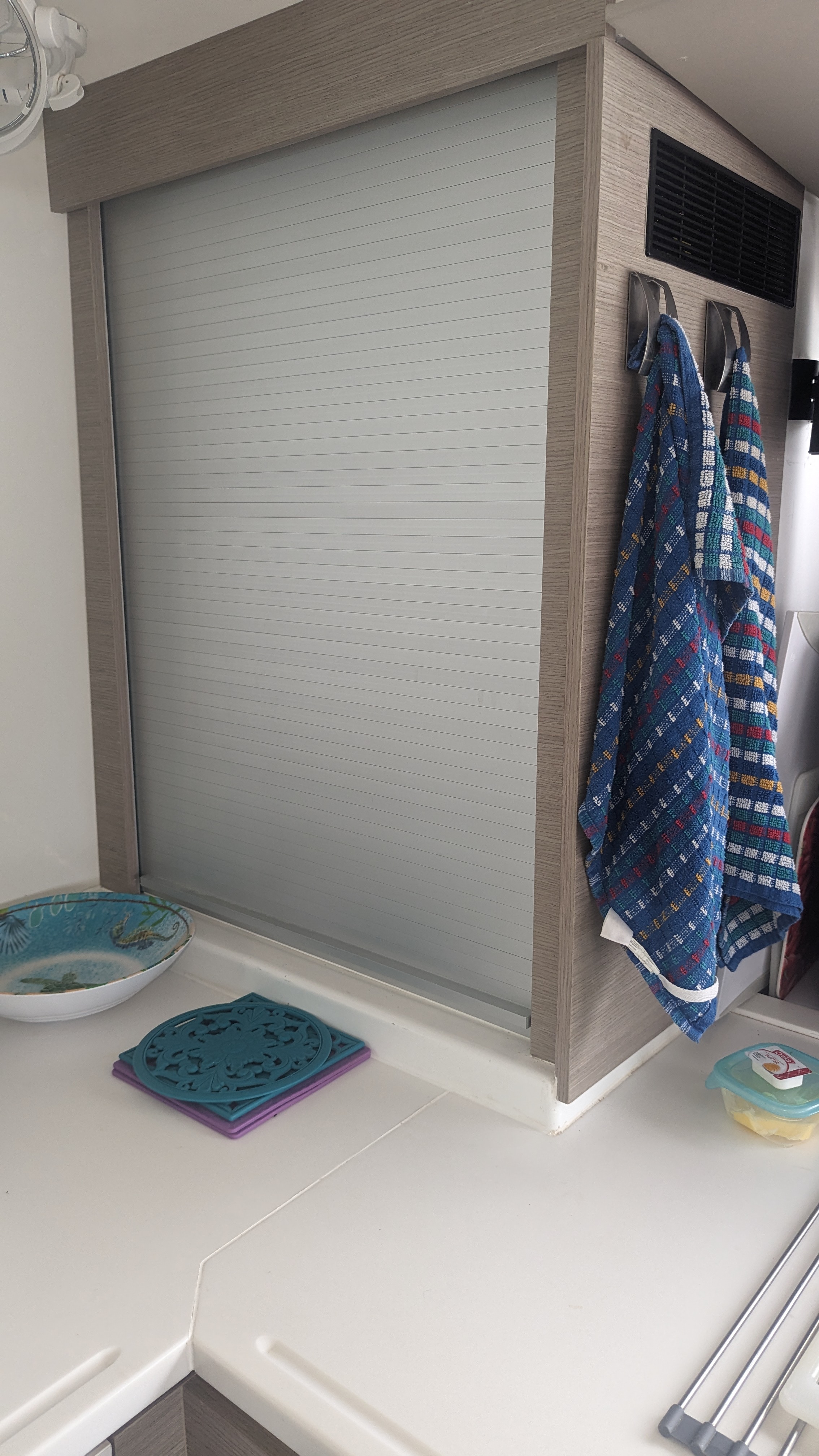
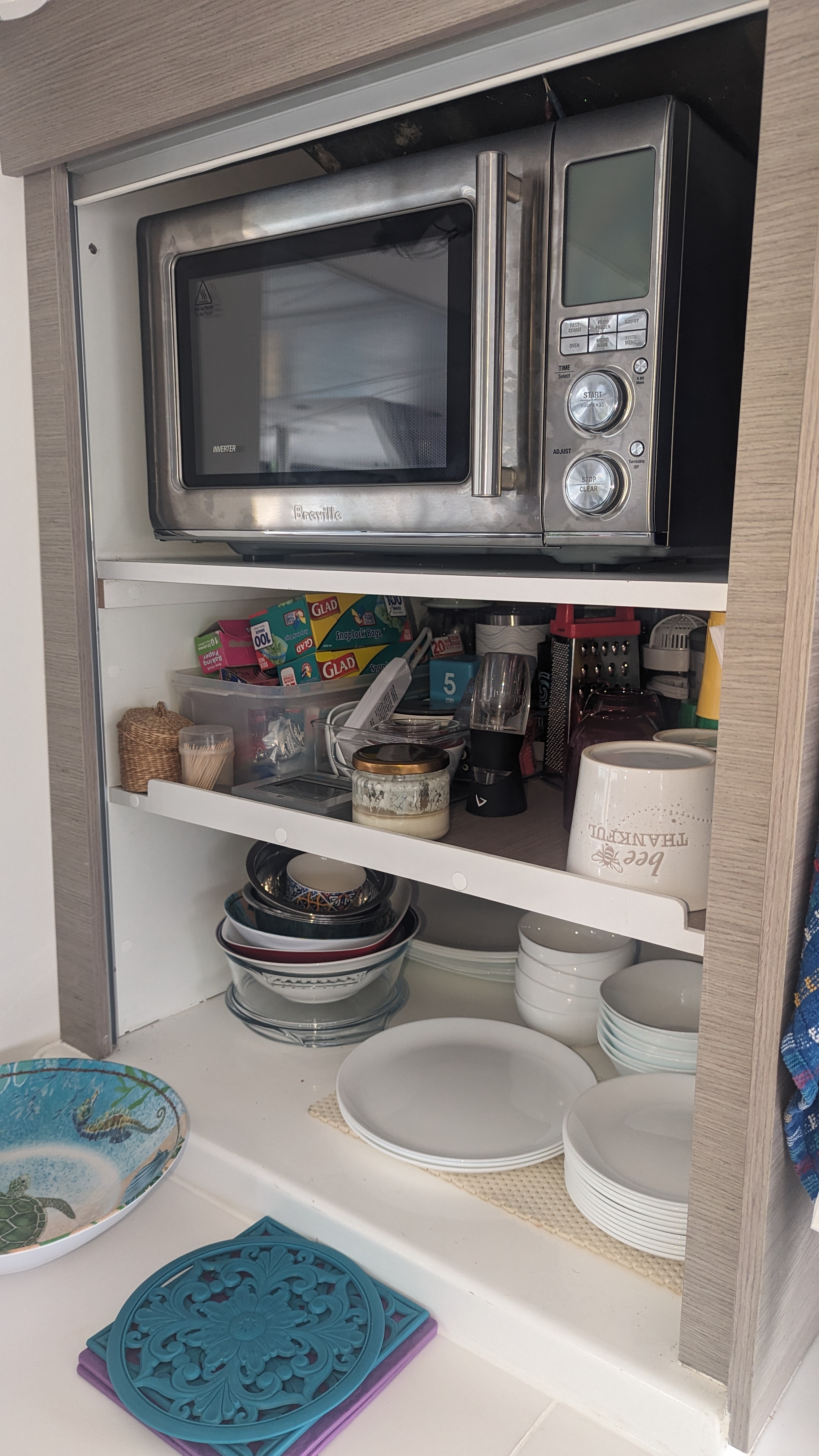
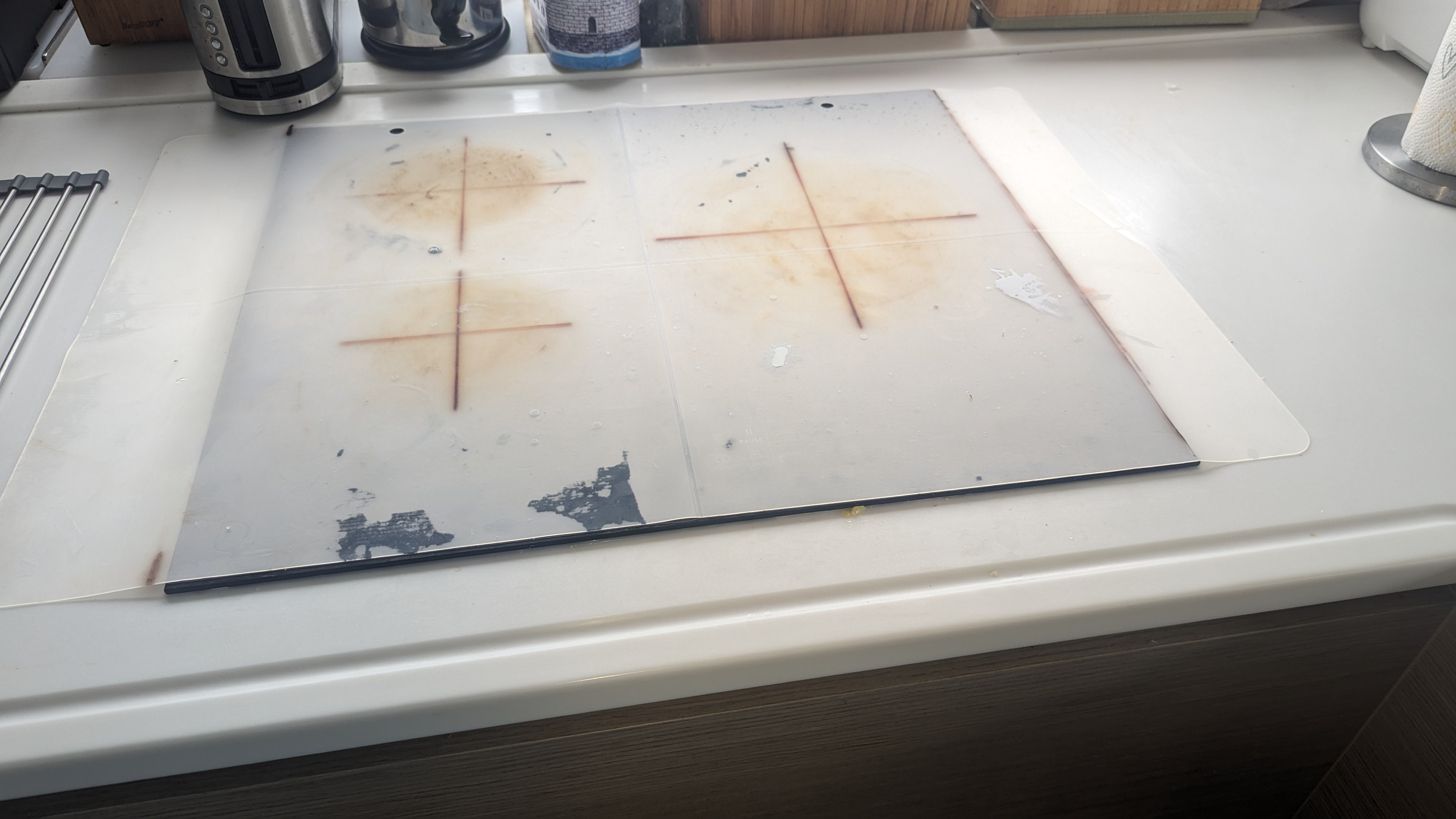
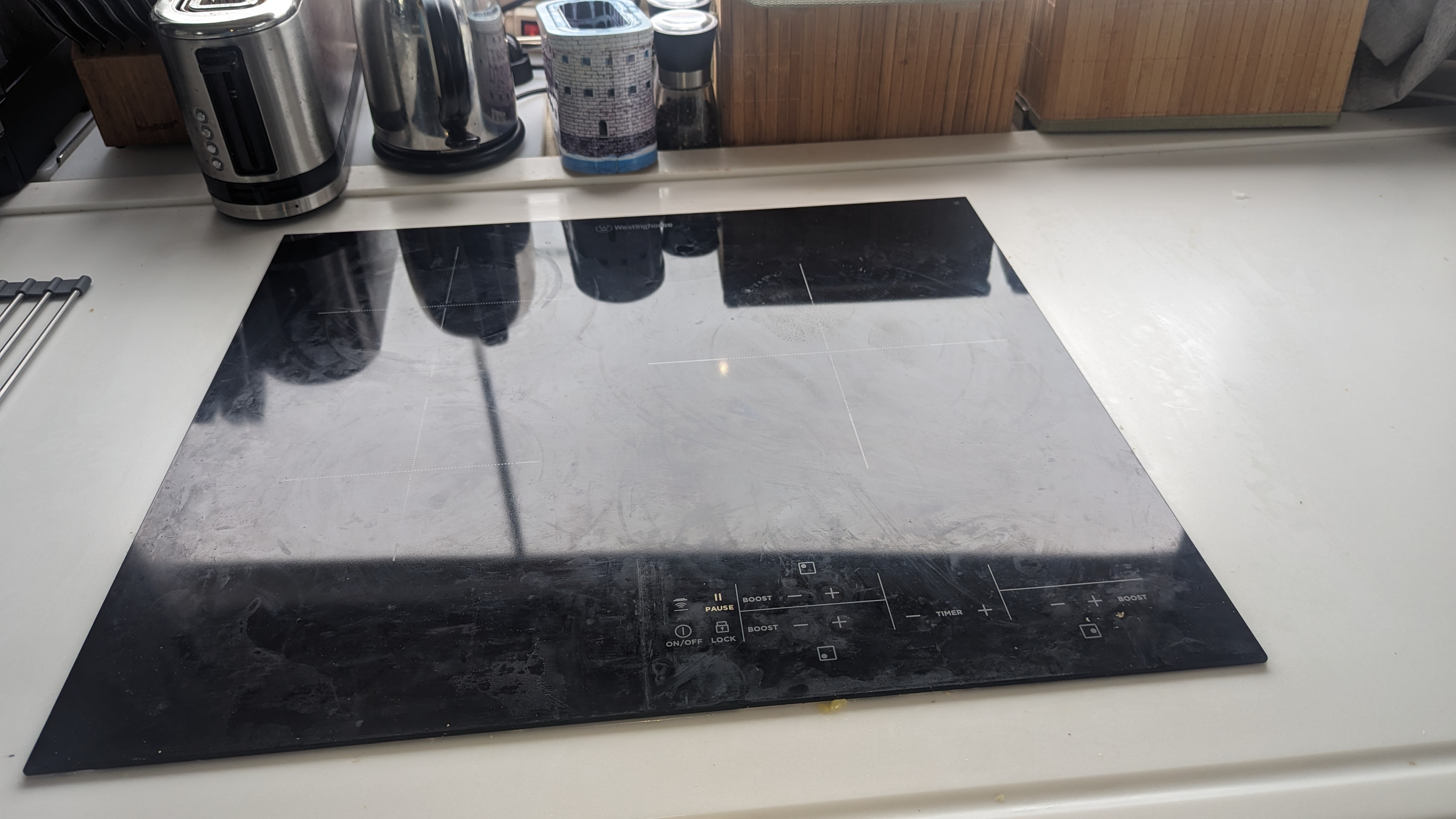
Meanwhile inside the boat we were busily ripping out the gas from the galley and going all electric with a new induction stove top and a Breville Oven/Microwave./Air Fryer combo. We’ve gone with a non-slip overlay for the induction cooktop which stops the pots and pans sliding, but as you can see it is a bit hard to clean. We also added a dishwasher (after numerous complaints that I was a lousy dishwasher) and turned some difficult to use cupboards into a nice set of drawers. The removal of the large gas oven gave us some extra storage room (which we needed as the dishwasher took two existing drawers away).

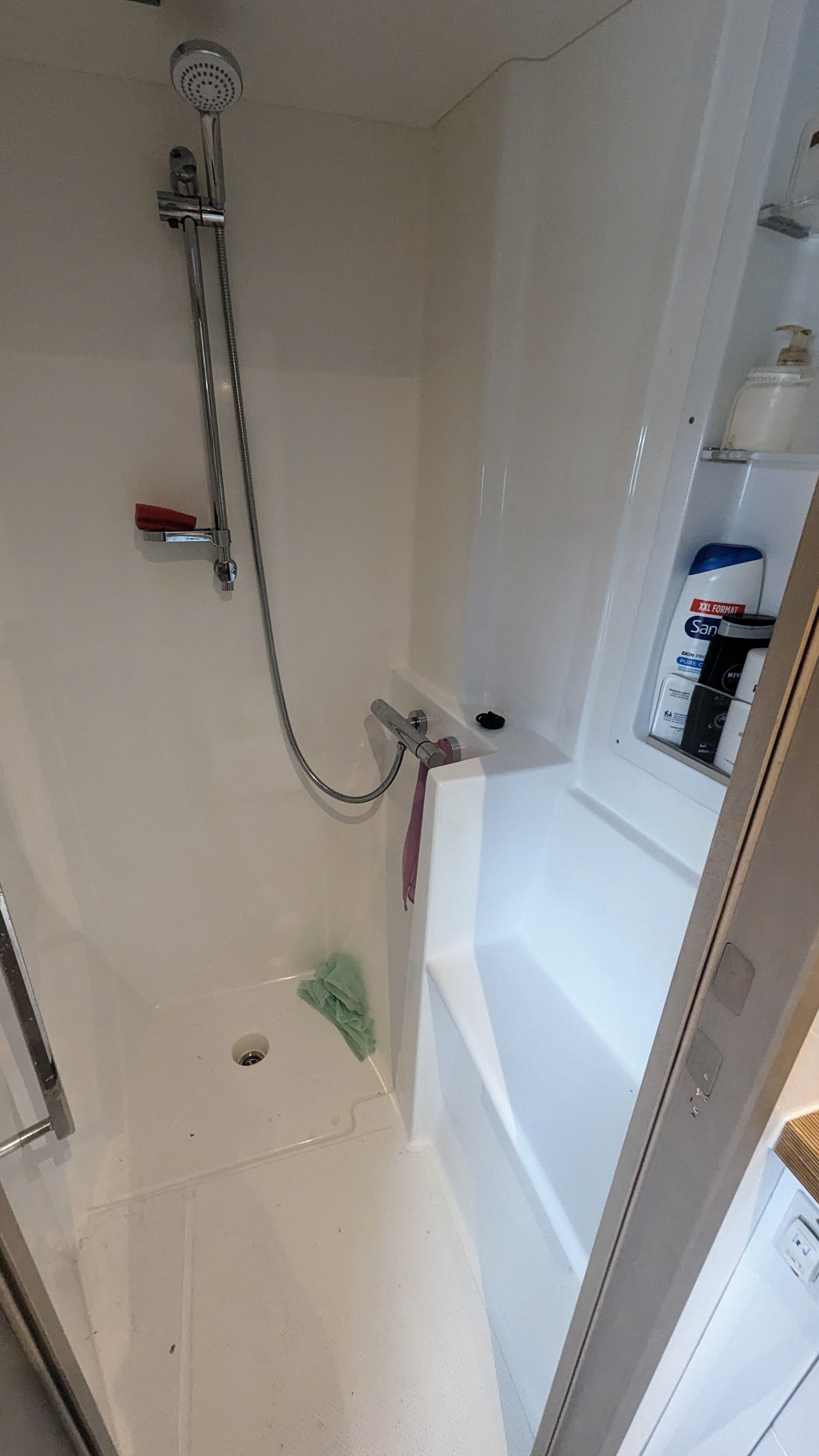
One of the things we loved about La Mischief (our previous Lagoon 421) was that the whole Port hull was devoted to the owners, with a bathroom at the front and a stateroom at the back with a sliding door for privacy. Fountaine Pajot did not offer this configuration in the Saba 50. So we had to do it ourselves by ripping out the forward stateroom on our side and put in a dividing wall so that we could have storage on one side and a new bathroom on the other.

The existing bathroom from the old stateroom was converted into a huge shower, with the head moved into the new bathroom from the old one. At the same time we added a bidet sprayer (obviously to remind us of our time in Japan – but not quite so fancy).

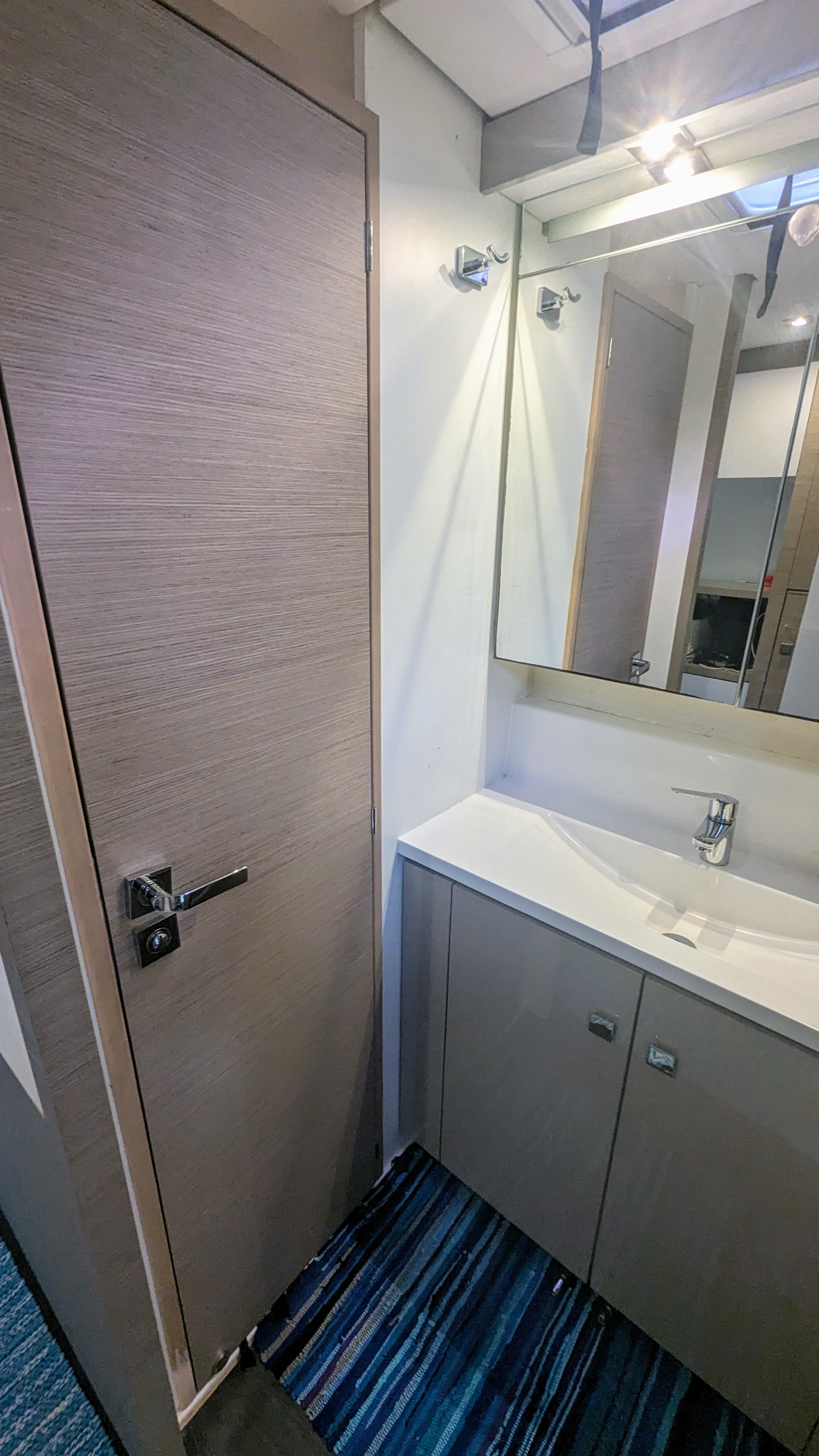
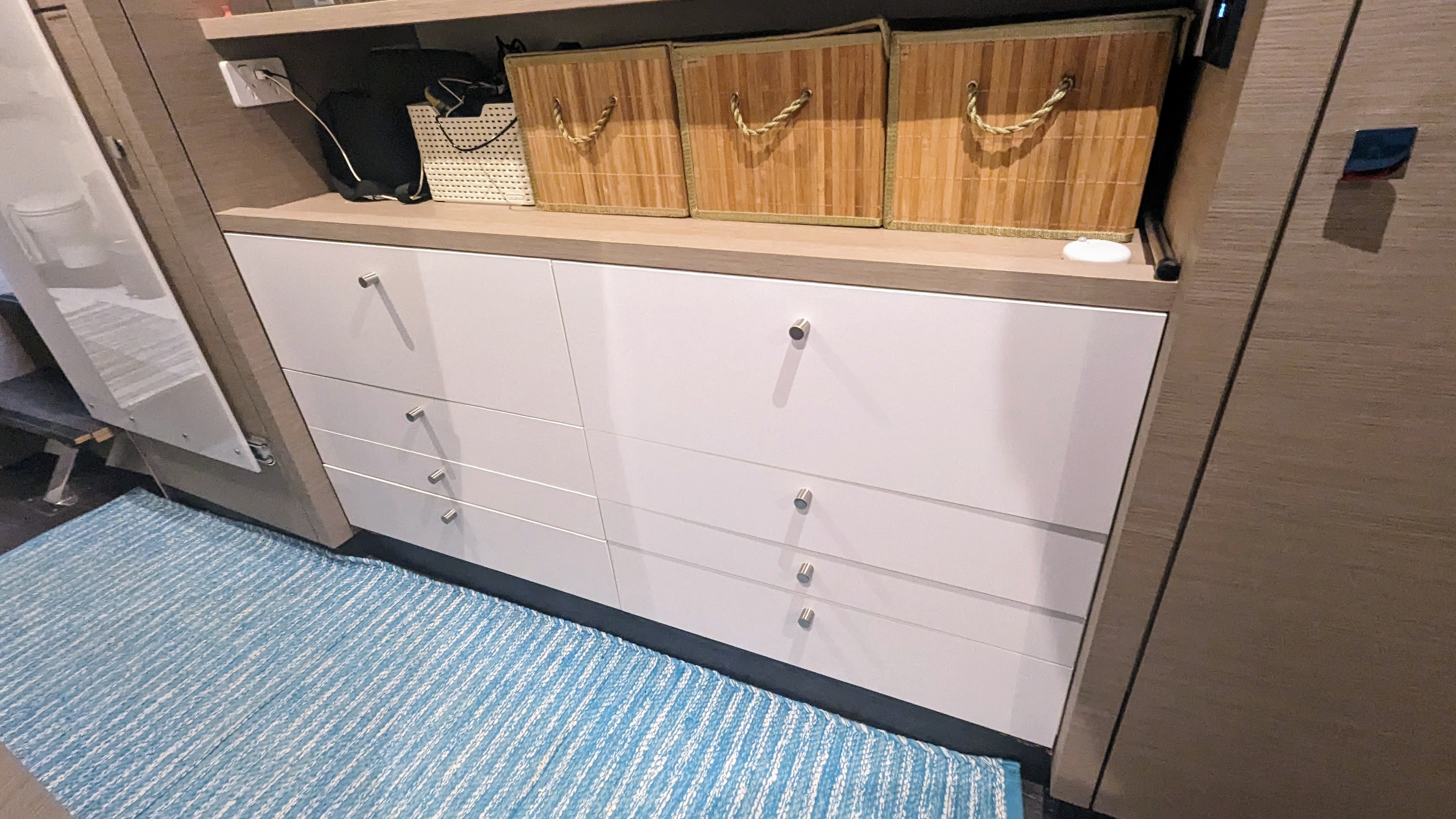
To connect our master bedrom to the new bathroom and provide privacy, we went with a perspex sliding door, which was bent into shape so that it curved across the top. We haven’t yet been able to source a suitable lock so it’s still a work in progress. The old shower and toilet cubicles in the Master Staterom were then turned into additional wardrobes for Dee (as a girl cannot have too much hanging space – evidently!). Whilst we were at it, we converted some cupboard space into much more usable drawer space in our master.
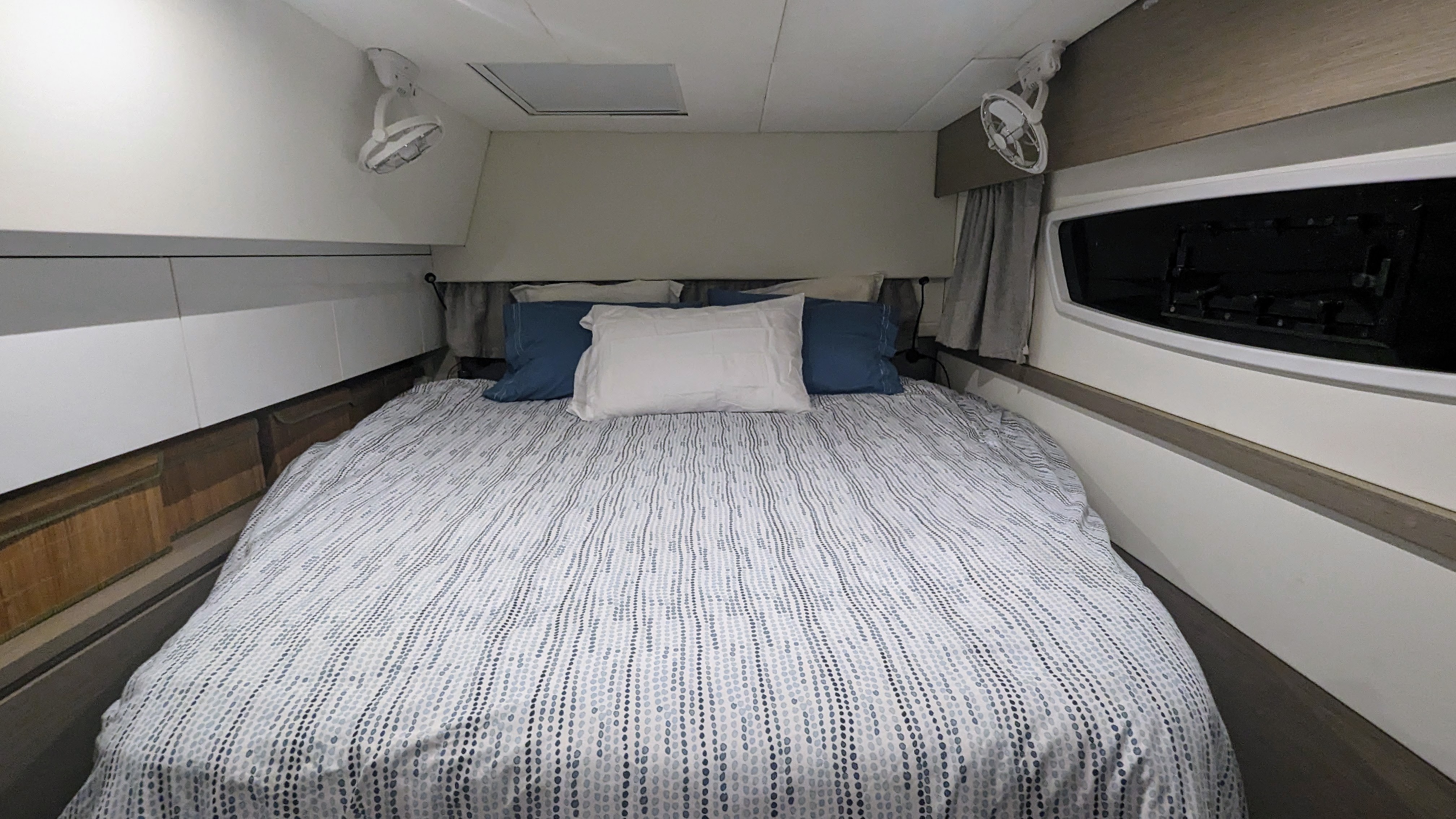
For the past three years, I’ve had to put up with a couple of steps pertruding into the master, right above where I slept. The newer Fountaine Pajot’s have done away with these, opting for floating steps at the back. So that’s what we did – cut out the steps and built some floating steps at the back, with a full length portlight for added airflow. So much nicer. At the same time we had a custom made pocket spring mattress from Brownies and now we sleep like babies.
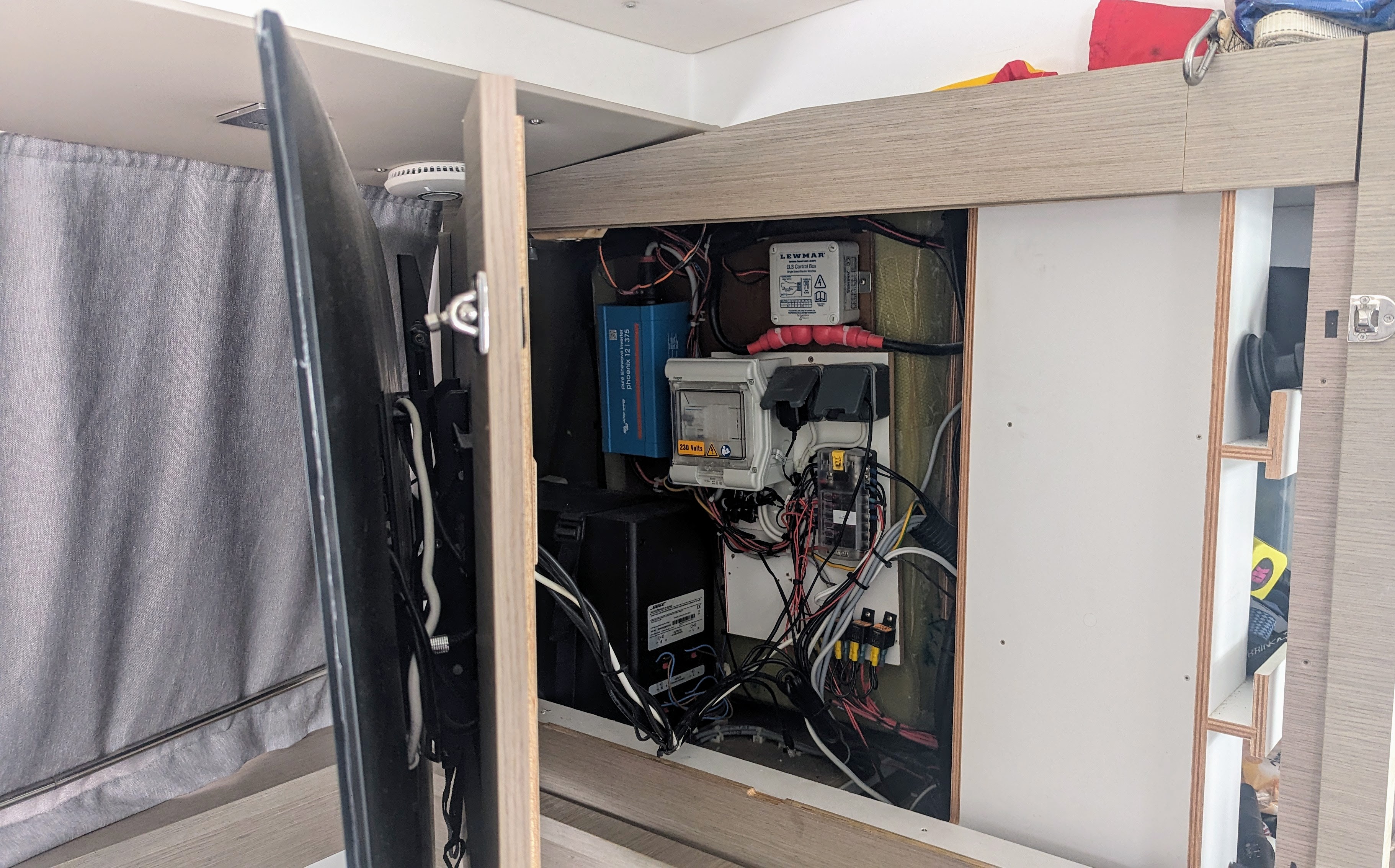
One of the most exciting things for me was a new dedicated electronics cabinet, in a void we found under the cooktop in the Master bedroom. It’s really nice having the Starlink, the Pepwave router, the Synology NAS, the BRNKL security system, the Predictwind Datahub and the Sonos Port (plus some of the powertool batteries on charge) all in a centralised and easily accessible spot.

On the subject of accessibility, we also installed a hinged backboard for the saloon TV, so we could get easy access to the winch controllers etc. behind the TV. No more removing the TV every time we wanted to get in there.
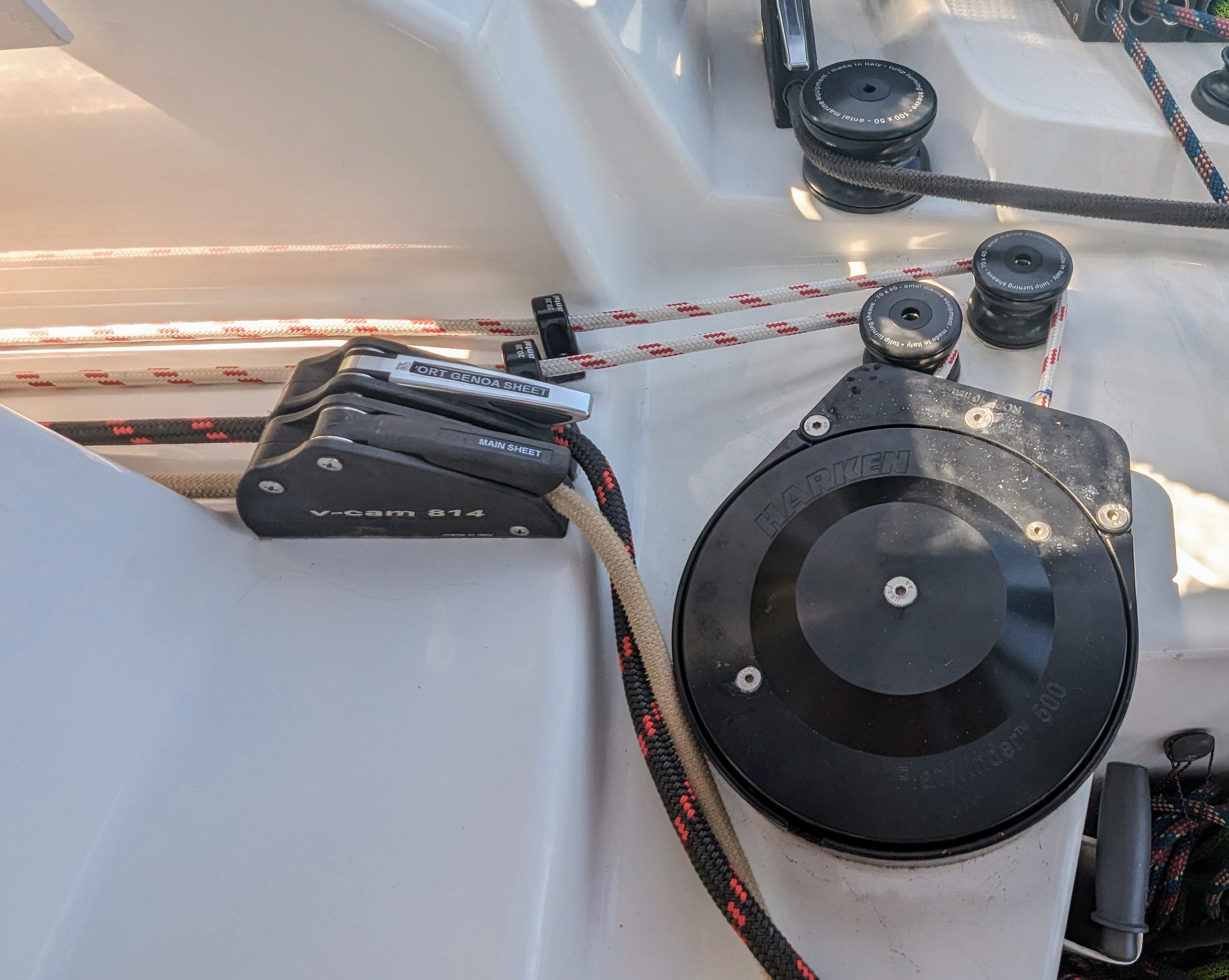
This was particularly useful when we were taking out the one manual winch and replacing it with a Harken Flatwinder for the traveller lines. Now we just have to push a button to take the traveller to Port and the other button to take it to Starboard. Too Easy!!!! It turned out to be a bigger job than expected as the BMS had to be upgraded to take the extra load. We also had an issue with its thermal overload not playing ball and Harken are sending a new motor under warranty up to us in Fiji. In the meantime we are being careful as we are using it without the thermal overload working.
With all our new electrical appliances on board, we needed to up our Solar charging capacity, with two new 550W Sunpower bifacial panels out the back of the existing panels. At the same time, we added a mount for the Starlink.
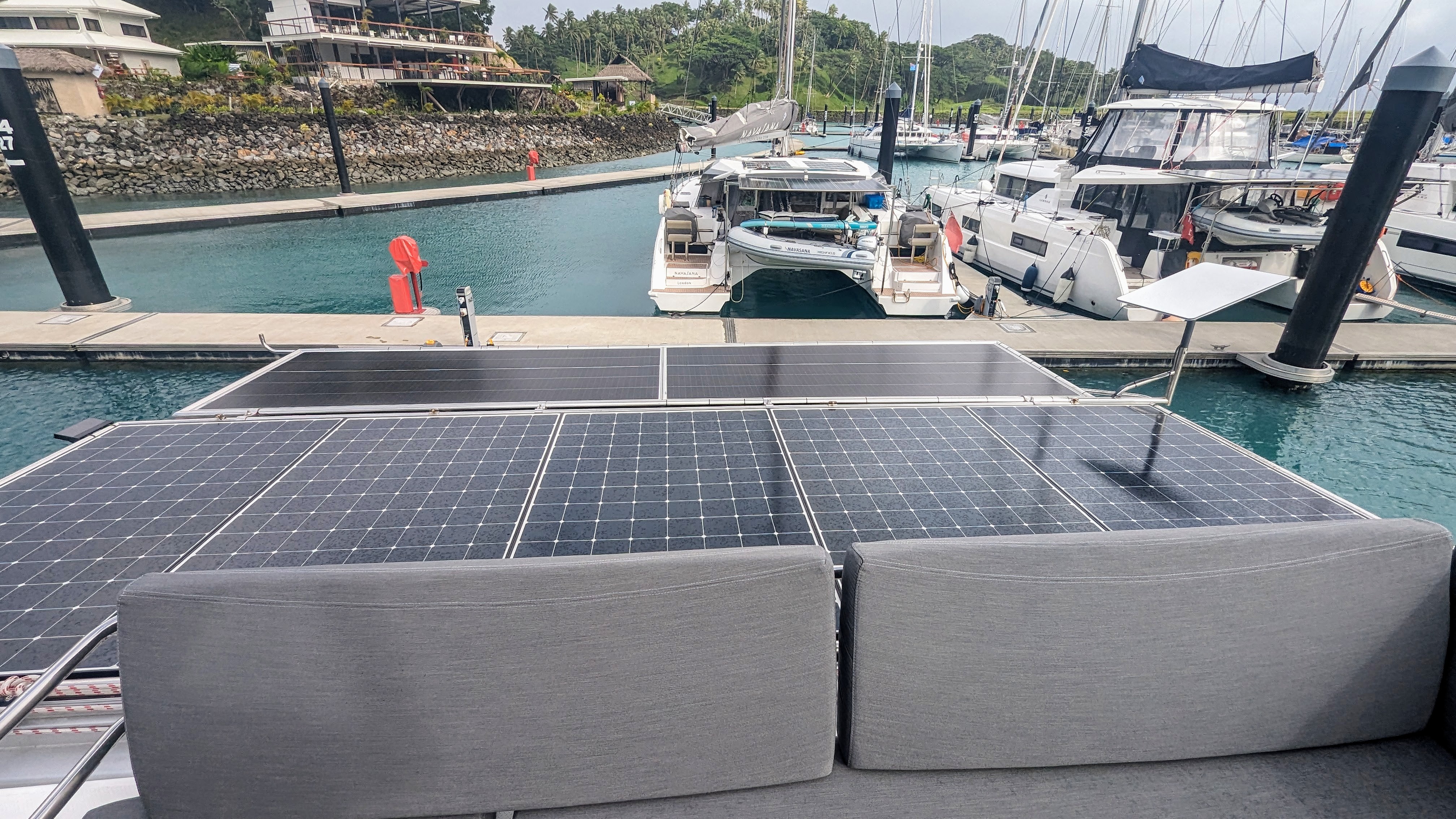
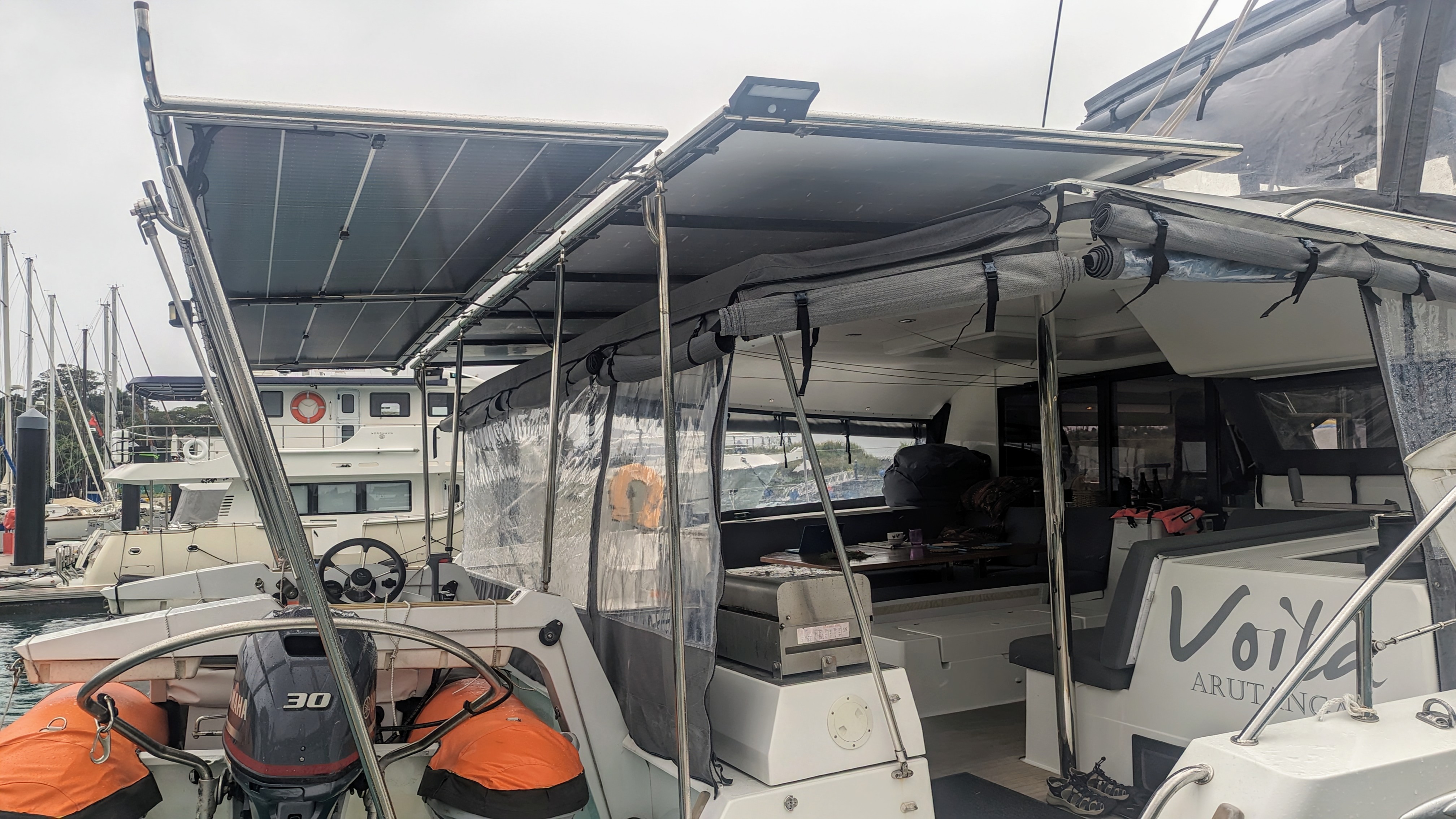
Up front, we put in a couple of extra portlights, for extra airflow in the tropics, plus the biggest deck hatch we could find for access into our brand new storage behind the new bathroom.

Talking of hatches, we added a new opening hatch at the side of the helm station so I can now see the Port aft corner of the boat when backing into a slip. Great for communication and airflow is a bonus. The other thing we did was to re-route the genoa furler line forward on a frictionless ring, with a new easily accessible jammer at the helm so it no longer traps us in the helm station when it is partially furled.

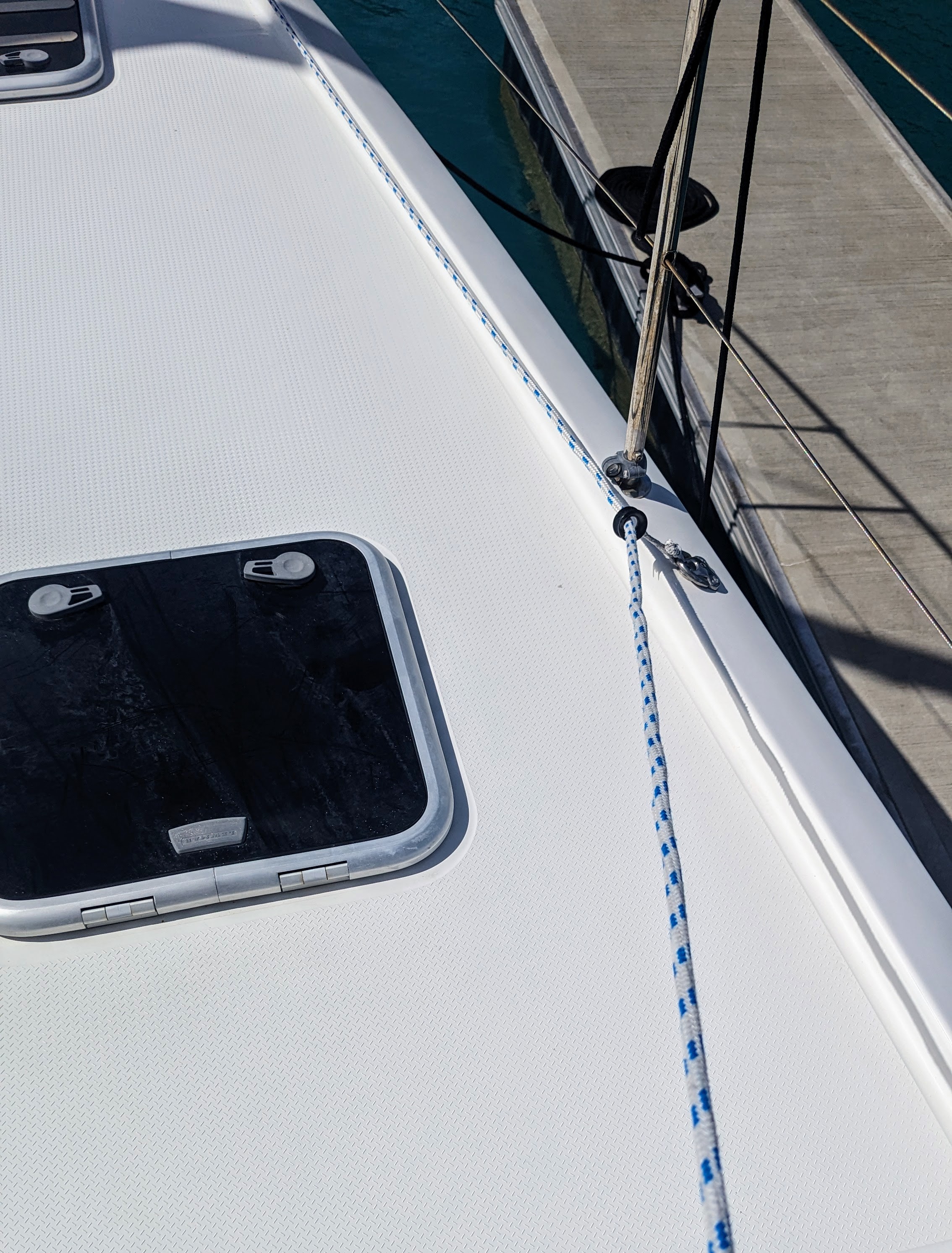
We also redid the lazy jacks with frictionless rings as it was previously impossible for Dee and I to wrangle it.

We relocated the dive compressor to the one and only lazerette it would fit into (after cutting some fibreglass away) so that it doesn’t overheat in the engine room and is a lot easier to manage. One less lazerette meant we required some additional storage for tools, which we found under the BBQ and where the old useless icemaker used to live.
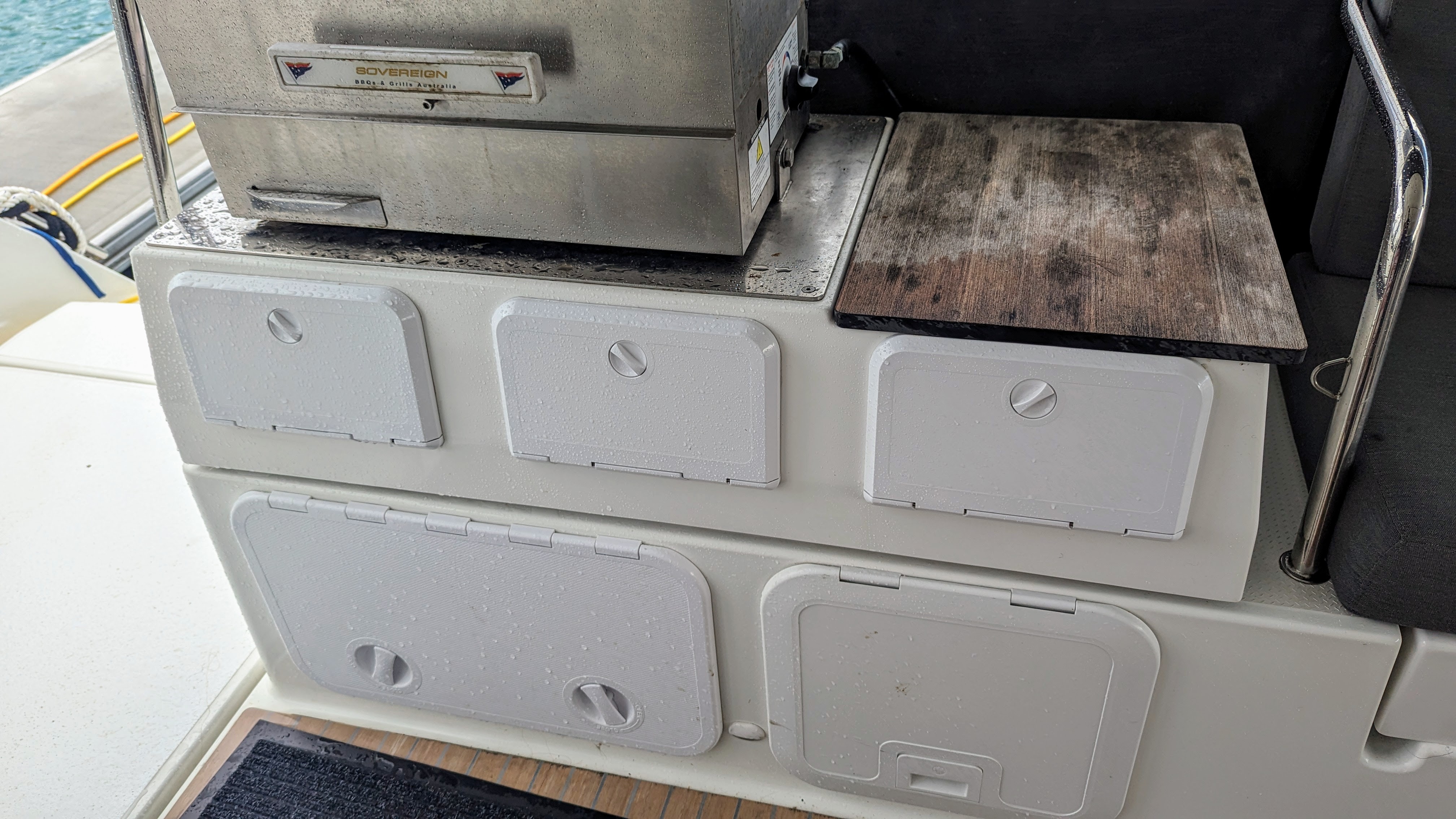
Lastly, we extended the stainless steel backrest on the lido deck to accommodate some extra seating, together with a new cushion to make much more use of the seating upstairs.
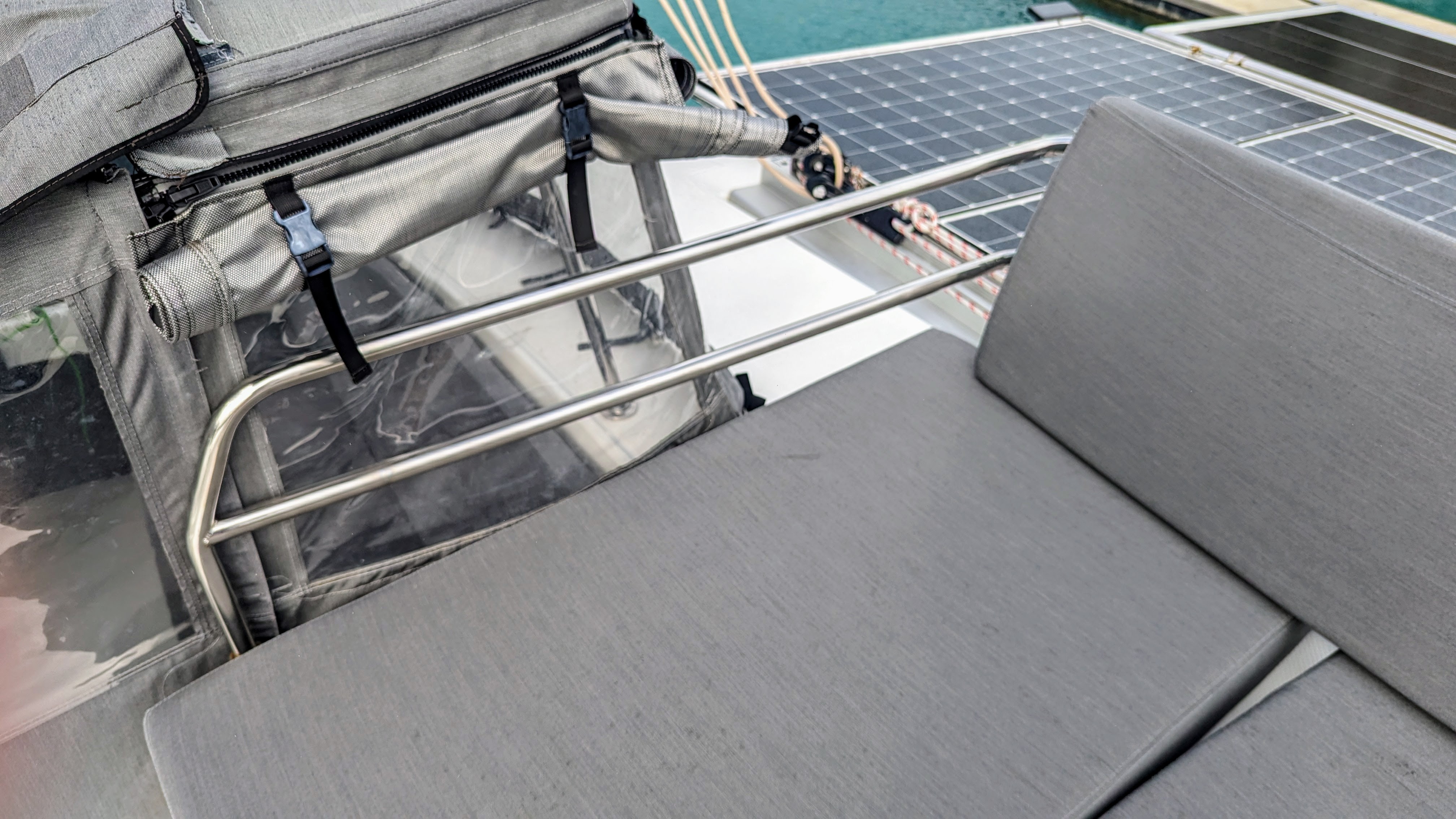
Upstairs extension. Cushion not shown.

So that’s it. I’ve probably missed the odd item but you can see we’ve been pretty busy. Now we are looking forward to enjoying the fruits of our labour cruising Fiji for the next couple of months in Voila 2.0.
Our Two Autopilots Setup

Introduction

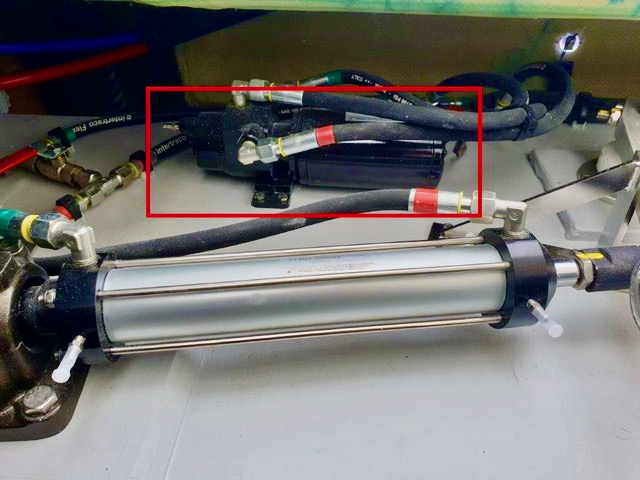
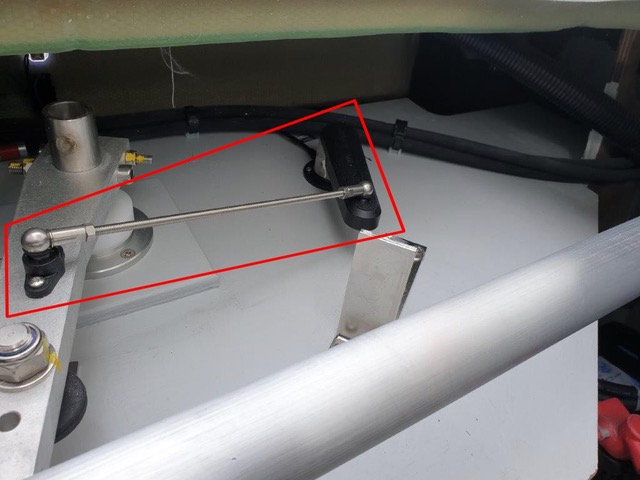
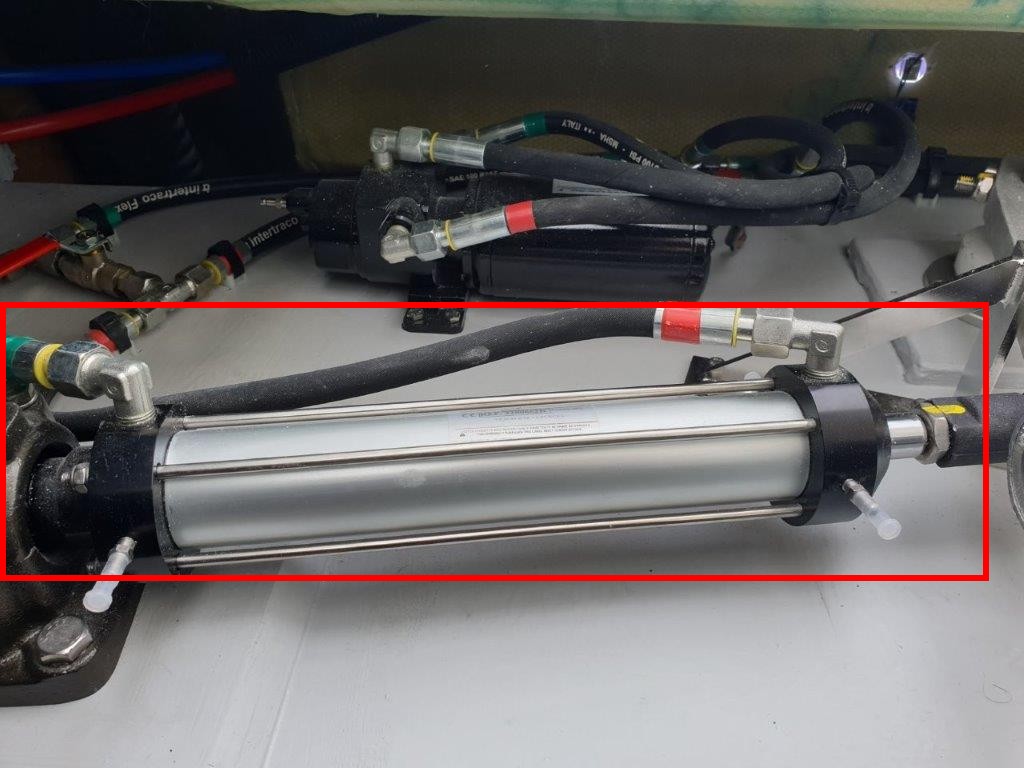
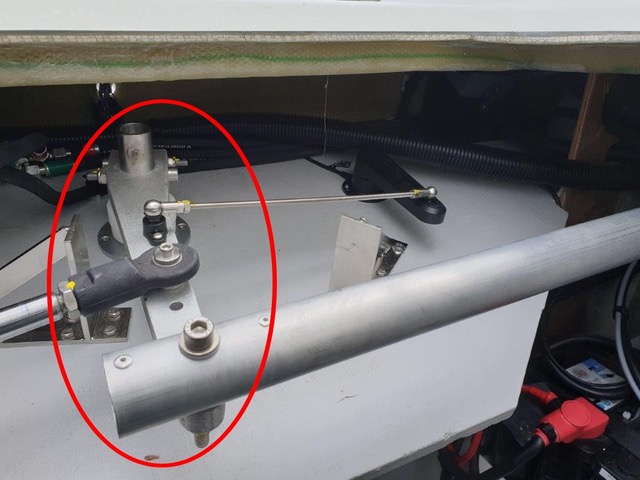
On our Saba 50 the steering system is a hydraulic system. The steering wheel operates a hydraulic pump, which itself operates a hydraulic cylinder (See Image 1 below) which pushes and pulls on the starboard rudder stock arm (Image 2 below). Note that we need to add a Rose Joint to this arrangement as the board that it is mounted on flexes and we are finding that the stainless steel bolt though the aluminium arm is leaving filings as it turns. John previously pointed out this problem to us and its on our jobs list.

Image 1: Hydraulic Pump for Steering
Image 2: Rudder Tiller

The starboard rudder is operated by the hydraulic cylinder and the port rudder is linked by a aluminium bar that joins both rudders together so that they move in unison.

We ordered the Garmin autopilot from FP and this works with a hydraulic pump (Image 3 below), which is installed on the hydraulic circuit of the helm system.

Image 3: Autopilot Hydraulic Pump in Starboard Hull

The autopilot pump will turn the rudders in either direction , and works in a similar fashion to the hydraulic steering that is driven from the steering wheel.

It is important to note that if either the hydraulic pump for the steering fails (see Image 1 above), then we also cannot steer the boat with the autopilot either. FP provides emergency steering for the Saba that you have to stand in the engine room to try and use. Totally impractical.

So not only did we need a second autopilot in case our primary autopilot failed, we also needed one in case our hydraulic steering failed.

Our Solution

Uchimata installed a Leroy and Smitt (L&S) cylinder (See Image 4 below) and a hydraulic pump (Image 5) on the bit arm of the port rudder. Our primary autopilot on La Mischief was also a L&S hydraulic system and we were very comfortable with this. We also kept hold of the maintenance kit, which is a bit of a bonus.

Image 4: L&S Autopilot Hydraulic Linear Drive Unit in Port Hull
Image 5: L&S Autopilot Hydraulic Pump in Port Hull

The operating principle is the same as for the main autopilot, but is independent of the helm steering system, thereby providing redundancy for this system also. We can throw away our emergency steering system (but haven’t). The L&S autopilot cylinder directly actuates the port rudder, with the starboard rudder being actuated by the aluminium bar linking the two rudders together.

To reiterate, we can now have a hydraulic break in our boat’s helm system, the steering wheel pump, the helm system cylinder or the main autopilot’s hydraulic system pump, and we can still steer the boat as the port system is completely independent.

Each autopilot has its own head, and each are equipped with feedback (Images 6 and 7 below), there is one for the main pilot on starboard and there is one for the second pilot on port. So no matter which autopilot we are running, we can always tell where the rudders are.

Image 6: Feedback Arm for Port Hull (Secondary Autopilot)

Image 7: Feedback Arm for Starboard Hull (Primary Autopilot)

The Second Autopilot

Now we have 2 autopilots on board, w must be extremely careful that we don’t have both on at the same time. This could be quite catastrophic.

Unlike boats with mechanical steering, on our Saba with its hydraulic steering the autopilot pump (See Image 3 above) is mounted on the hydraulic circuit and “closes” the system, meaning the steering wheel is effectively disconnected whilst the autopilot is engaged. Disengaging the autopilot “opens” the hydraulic circuit and allows the steering wheel to once again be engaged. Therefore to use the second autopilot we must also do this but manually by turning a ball valve to cut the pressure to the ram. This is the same ball valve that was installed to allow the emergency steering bar to be used.

Image 8: Bypass Valve in Starboard Hull (in closed position – Helm and Primary Autopilot in use)

When the second autopilot is used, the bypass valve (08) must be opened.

Whenever the bypass valve (Image 8 above) has been opened and then closed, its very important that you use the feedback (Images 6 and 7) to ensure that the rudders are in the axis of the boat.

Step By Step Guide to Using the Second Autopilot

  1. Make sure the rudders are centred using the feedback on the Autopilot Head.
  2. Make sure the main pilot is on stand-by.
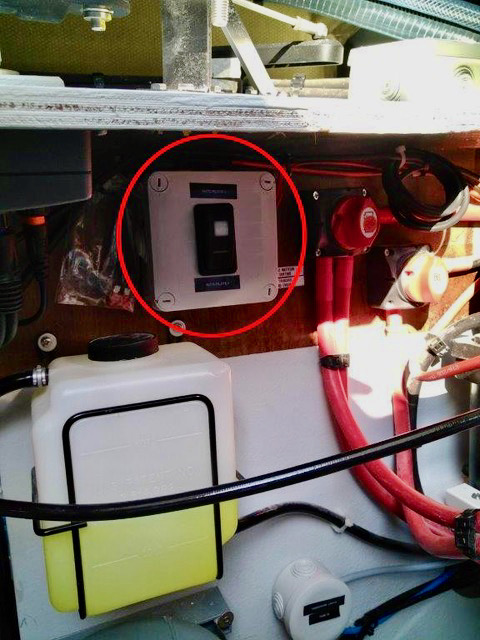
  3. Power on the second port autopilot by setting the switch ( Image 9 Below) on the second pilot.
Image 9: The Power Switch for Moving Between Autopilots

4. Open the bypass valve (see Image 8 above) and simultaneously set the second autopilot to AUTO (Head unit is under winch).

At this point, the second autopilot will be steering the boat. Its important to note that manual steering is unavailable when this second autopilot is being used.

Moving Back to the Primary Autopilot

  1. Make sure the rudders are centred using the feedback (see Images 6 and 7 above) that displays on the Autopilot Heads. This is very important.
  2. Make sure the secondary pilot is on standby.
  3. Power on the primary autopilot by setting the Power Switch (see Image 9 above) to the primary autopilot.
  4. Close the bypass valve
  5. Set the Primary Autopilot to Auto.
  6. Test that the Steering works by disengaging the autopilot briefly to test.
Testing the 2nd Autopilot

The first time we tried it, it didn’t work. We had Sopromar in Lagos look at it and they set the “Drive Unit Class” to Solenoid and Voila!, we got power to the ram and it started working.

Flying the Flag

But which flag?

Now that its not an option to have an Australian Flag with the name of my Footy team (Fremantle) on the back on the boat, we need to have a good think about where to register our new Saba 50. Australia is not an option as Dee and I will be jointly owning the boat and for it to be an Australian boat it needs to be majority owned by an Australian. 

So we need to look around for an alternative. And there are a few that spring to mind. 

But there’s a few factors to consider: 

  • Cost – Initial and Ongoing Year to Year
  • Risk – Can we use a US Limited Lability Company or do we need to set up a Company in Country. And how much does that cost?
  • Radio License and EPIRB Registration
  • Insurance options for the various flags. 
  • Reputation and Coverage.  
  • And finally….Do we like the actual flag? Does it have an annoying Union Jack in the corner?

USA Flag out of Delaware is the easiest and cheapest solution – we can set up a jointly owned Limited Liability Company in Delaware and have Wilmington as our home port all for $947USD (using http://www.boatandyachtregistration.com). However, I’m not so sure I want people to think I’m from the USA. 

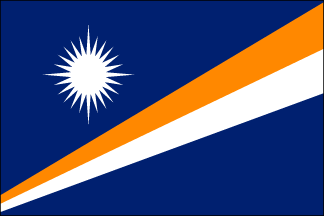
As far as a homeport goes, Bikini from the Marshall Islands sounds rather cool. However, we would need to set up a Marshall Islands company. Every Marshall Islands LLC must appoint a registered agent and maintain a local office address. Not 100% sold on either an LLC in a far-off land; or the flag for that matter, but at least it doesn’t have that annoying little Union Jack in the corner.  Interestingly, the Marshall Islands Registry permits private yachts to be chartered out for up to 84 days per calendar year, provided that some additional requirements are satisfied. Fees are: $2800.00 Year 1 (Company setup and Boat Registration) and then $1800.00 (Year 2 and onward – Company and boat renewal).

A good looking flag is important and we really like the Maltese Flag. However a Maltese flag means we cannot get VAT exemption if we are in the EU. So that rules it out in the short term whilst we are in Europe. Registration Fees are 115 Euros, plus an annual fee of 425 Euros plus VAT. To this we need to add costs for a Radio license and an MMSI number. Plus the cost of local representation. 

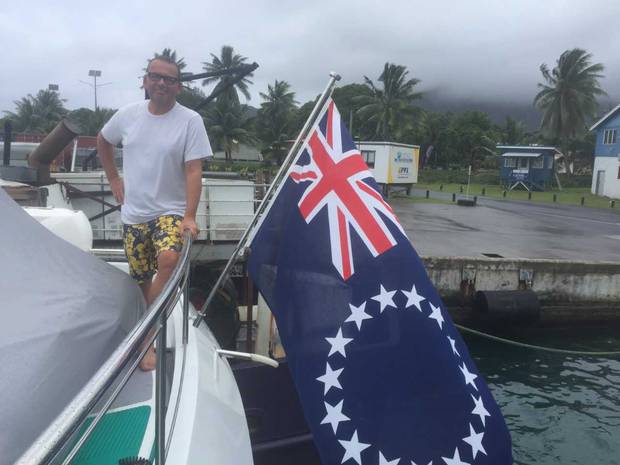
Multihulls Solutions are very experienced with registering boats in the Cook Islands and Captain Cook is pretty much up there when it comes to sailors. Fees are $800 for one year, $2100 for 3 years. The easiest way to register a boat in the Cook Islands is to join The Cook Islands Yacht Squadron (CIYS).  Members of the Cook Islands Yacht Squadron (CIYS) are eligible to have their yacht registered in the Cook Islands without having to register a company. The definition of person includes companies and trusts as well as individuals or partnerships of individuals. In this way foreign corporation can become a member of CIYS without having to register that corporation in the Cook Islands. However the Cook Islands flag has that annoying little Union Jack in the corner. Cook Islands is the only option that my current insurer, Topsail Australia (who I am very comfortable with) will cover, however interestingly they can’t provide cover when we actually sail into the Cook Islands because of some strange licensing quirk.   

We saw a lot of boats with Jamaican flags and again Montego Bay has an air of the exotic as a home port. Jamaica also has a Private Limited Charter option where the yacht may charter up to 84 days per calendar year where permitted. Ownership can be with any legal entity in good standing or an individual.  There is no requirement to create a new owning entity in Jamaica. Fees are The Private Yacht Only (PYO) option is $1950.  The Private with Limited Charter (PYLC) option is $2500 (plus $4100 for a survey).  Ongoing annual fees are $750, and if chartering an annual charter survey is $3,575.   These fees include vessel registration, radio license, tonnage, registered agent, all documentation, and a flag.

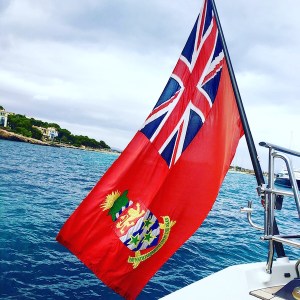
Quest, a fellow Saba 50, went with a Cayman Islands flag and that’s not a bad choice (except for that annoying little Union Jack in the corner once again).   A USA LLC can own a Cayman Islands Registered Vessel so that’s a tick. However, a foreign LLC must appoint a representative in the Cayman Islands (at an additional annual cost no doubt). Like the Marshall Islands, the Caymans also have a Yacht Engaged in Trade (YET) program for yacht operated privately that provides the option to charter their yacht for up to 84 days per year. Costs are $1200USD for initial registration and $530USD for each year after that (according to https://www.cishipping.com/feesandcalculators).

Having digested all this, I’m not sure there is a clear cut option for us, so some more thought is required. Once again, all suggestions and further information will be gratefully received. 

Music to Our Ears

Listening to music is a really important part of our boat life. On our old boat we used to download music to our phones or tablets using Google Play Music so that we could access it offline …internet or no internet. We also had an old iPod with music downloaded on it that was connected to our Fusion Stereo. But most of the time we would connect up our phones or tablets and play the downloaded Google Play music.

The biggest problem with this was bluetooth’s short range and one user at a time restriction. Quite often we would sit out the back and suffer poor or no bluetooth connectivity. With the Saba being a lot bigger this was going to be even more of a problem.

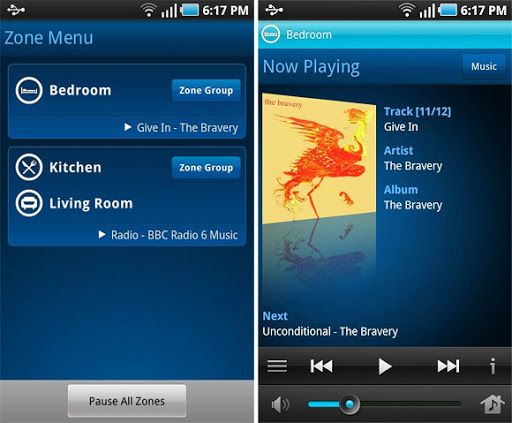
Enter Sonos with its capacity to play music over a much better (than bluetooth) Wifi connection (provided by our Pepwave router). Our Saba comes with the same Fusion Marine Stereo as before and our plan is to hook up a Sonos Port unit to the Fusion and voila…we can use Sonos to play all our Google Youtube music over Wifi from ANYWHERE on the boat. Likewise our guests will also be able to download the Sonos app and hook into our system so we can listen to their music as well. And finally, we can download all our music that sits on our hard drives (and in Google Play Music) to our DS118 NAS that sits on our boat network so we can access this from Sonos as well.

I loved my previous Sonos system from my time as a dirt dweller, and I’m keen to use it once again.

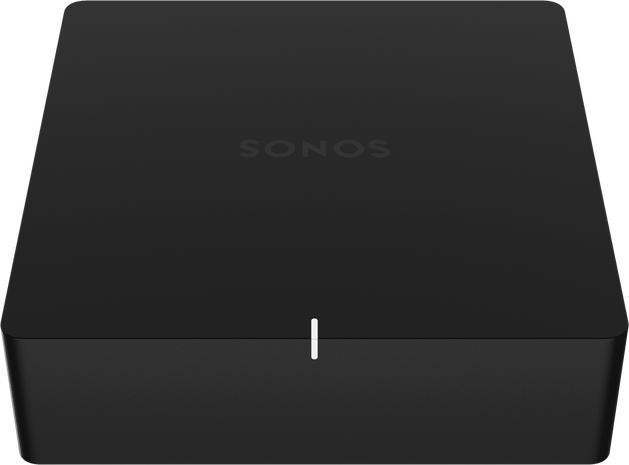
The Sonos Port is an upgrade from the Sonos Connect and I should now be able to turn the Fusion Stereo on and off from the Sonos system – how cool is that. And it will also control the volume of the Fusion as a whole, but I don’t think it will control the volumes of the individual Fusion Zones.

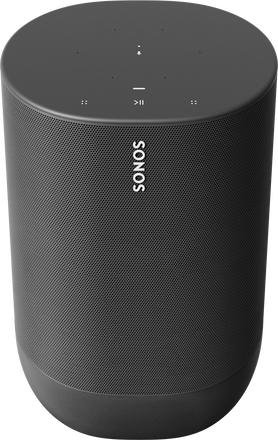
The other purchase will be a Sonos Move, the new Sonos outdoor battery powered speaker, that has got rave reviews. We have gone ahead and purchased one Move (we plan to get a second in France) and are loving it. The Fusion System that comes with the boat only comes with speakers in the saloon and the cockpit and the Sonos Moves will fill in the sound gaps – the upstairs lounge and the front deck in particular. And we won’t have to drill holes in the boat to provide for additional wired speakers. As the Sonos Move uses both Wifi and Bluetooth we can also take it to the beach where there is usually no Wifi.

The final piece of the puzzle is a Sonos soundbar for the TV downstairs. Upstairs in the saloon, we will have a Bose system (same as before) and I need to think about whether I hook this into the Sonos system via another Sonos Port or just leave the Bose as a standalone movie and TV system. Kim suggested that Music sounds so much better with a subwoofer, which the Bose system has, or is our money better spent just buying a Sonos Sub? And do I need a Sonos Playbar upstairs with the Bose system for watching movies? Ummm. A little bit more to think about. Especially since I need to consider battery draw in the equation.

Even with the Bose System upstairs, TV sound was always a problem downstairs and a good soundbar will make movies much more enjoyable. Plus we can use Google Assistant or Alexa for voice controls.

The beauty of using an all Sonos solution is that we can play the same music throughout the boat across both the Fusion stereo, the Sonos Playbar and Sonos Moves.

I’ve just ordered a Sonos Move to use at home so it will be interesting to see how the first piece of the puzzle goes. The rest of the Sonos components will be sourced from the Sonos dealer in La Rochelle.

Update from the Factory

For those of you who are wondering what’s happening with regards to the delivery of our new Saba 50, which was due to roll out of the Factory in June, here is the latest update from Multihull Solutions, our Fountaine Pajot agent in Australia….

Dear Client 

I hope you have had a good week since my last update. The situation overseas is as follows:

  • France is still in lock down. They are reviewing the situation and renewing the isolation in fortnightly increments. I have been told they are likely to extend again, following the fortnight they are currently in. They are optimistic the work force will start to come back from the 4th of May. This ties in with the schools in France returning following the Easter Holiday.
  • The Fountaine Pajot factory is in the Charente-Maritime department of the region Poitou-Charentes, in the north west of France. Romain is in lock down in Quimper in Brittany, further north. The west/north-west of France is the least affected by the COVID-19 virus. The east being worst affected, as it is connected to the rest of mainland Europe. The yard Managers are optimistic that the region is contained and they will be one of the first back to work……. We will have to wait and see?

Please call me or e mail me if you have any questions regarding your order.

(Note. I will not have any updates on delivery times until such time that the French Government allows the production lines to start work again)