
Really disappointed to miss this annual event. Its held in January each year in Selcuk in Turkey. See Annual Camel Wrestling and Video.
Annual Camel Wrestling Championship
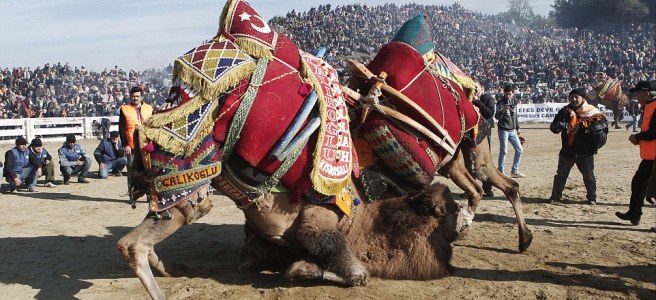
Really disappointed to miss this annual event. Its held in January each year in Selcuk in Turkey. See Annual Camel Wrestling and Video.

Just when I thought I was done for the year, Kim pipes up and suggests I publish my top 10 for the year. So here goes….

2. Paragliding over Oludeniz – most fun we’ve had in a long time.
 3. Lindos on Rhodes – beautiful bay underneath a stunning acropolis – a natural citadel which was fortified successively by the Greeks, the Romans, the Byzantines, the Knights of St John and the Ottomans. The town underneath the acropolis is brilliant with great little shops and ships captains’ houses that have been converted into restaurants and bars. See https://lamischief.com/2015/09/05/en-route-to-a-birthday-party-hope-we-get-an-invite/


4. Skopolos – enchanting Greek island with beautiful wooded bays and pebble beaches. Surprisingly bereft of Mamma Mia glitz, but the church from the film was a very impressive setting. And a great seafood platter for lunch that Dee hasn’t stopped talking about. See https://lamischief.com/2015/08/22/skiathos-mamma-mia-on-mondays-wednesdays-and-saturdays-anyone/

5. Santorini – visited for the third time and still as picture perfect as ever. Managed to visit a few different places this time – Ancient Thira was a find as was Gaia Winery right on the beach. See https://lamischief.com/2015/08/25/santorini-still-stunning-the-third-time-around/

6. Little Cyclades – sailed straight past these islands in previous years but this time we headed to the islands of Koufonissi, Iraklia, and Schinoussa. These islands are one of the best kept secrets with the chora at Koufonissi the highlight of the group. See https://lamischief.com/2015/08/28/touring-the-little-cyclades-with-the-uncanins/
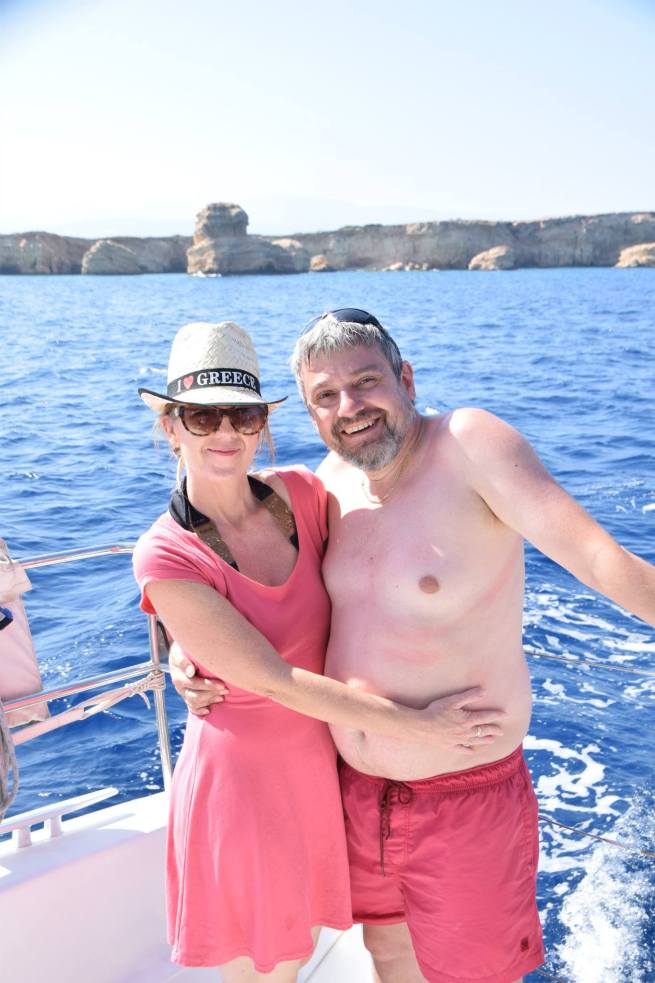
7. Kasterlorizo – party time with 50 other Aussies – what more can I say. Thanks Greg. See https://lamischief.com/2015/09/05/en-route-to-a-birthday-party-hope-we-get-an-invite/


8. Side – Mustafa looked after us superbly as we waited out a nasty storm in an ancient harbour – wandering through great Roman ruins that were right on the waterfront. See https://lamischief.com/2015/11/06/the-wind-arrives-followed-by-hugh/


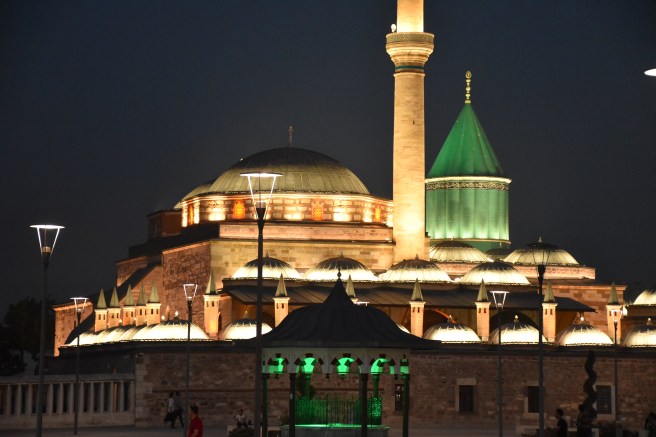
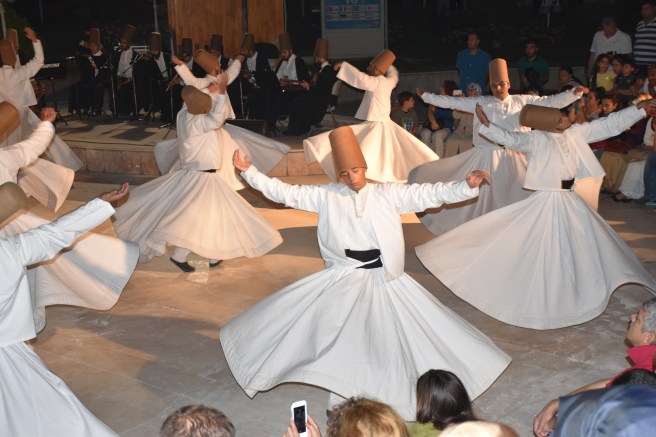
9. Konya – The stunning Mevlana Museum – especially when lit up at night, the Whirling Dervishes, and the Lamb , the beautifully slow cooked tandoor kebab, so nice we had to visit again and pig out on 500g of Tandoor Lamb each.
10. The Beaches of Mikonos – super cool and super beautiful. See https://lamischief.com/2015/08/24/tour-de-party-islands/


Honorable mentions go to

Now that I’m back in WA, its time to finish off the blogging for 2015 and write a little about our time exploring the North of Cyprus.
Depending on your point of view, the North is either referred to as the Turkish Republic of North Cyprus or The Occupied Territories.
Whatever your point of view is, there’s a bit to see in the North. In a nutshell, there’s three main fortified cities in Farmagusta, Girne and the divided capital of Leftkosa, three pretty cool castles (Kantara, Buffavento, and St Hilarion) perched high up in the mountains, the Roman ruins at Salimas and some nice monasteries in various locations.

With a great little hire car, we started with Famagusta on the East Coast, which took us an hour and a bit to get to. We got a lot of mis-information about the North before we got there; and we were pleasantly surprised when this information proved to be incorrect. For example, we were told the roads were fairly basic but in fact there were really nice roads everywhere. Famagusta is an old medieval fortified city, with city walls extending right around the old city down to the harbour. Othello’s Castle is a highlight, where a certain Mr. Shakespeare set his play of the same name. Further along the wall, there is the Venetian (winged) Lions of St Mark. Next to the town square in the old city is the Lala Mustafa Paşa Mosque, which started out life as a wonderful looking Gothic St Nicholas Cathedral in 1100AD. Everywhere you look in the old city, you see ancient sites, some are in good condition and some are ruins, all within the same fortified walls, that are great to walk on top of.

After checking out the old city, we wandered across to the modern district, which is now a ghost town. Back in the early 70’s, Famagusta was one of the “It” destinations for the 70’s jet-set, attracting thousands of visitors each year to the modern district, where the luxury hotels and apartments were situated next to an idyllic looking beach. But 40 years ago, this paradise came to an abrupt and untimely end.

Following a Greek military coup in July 1974, Turkish forces invaded. Turkish tanks got as far as this beachside strip and what is left now is a Demilitarised Zone patrolled by the UN between the north and south, full of bombarded and crumbling hotels and apartments, right next to one of the nicest beaches in Cyprus. Its quite surreal and sad, a waste in every sense of the word.

Outside Famagusta we visited the Saint Barnabas Monastery & Museum, which was worth a look see; and Salamis – the ancient Roman City that was the one time capital of Cyprus as far back as 1100 BC.

In its heyday, Salamis was up there as far as ancient cities of the world went, although now its lost a lot of its magnificence through a series of earthquakes and the pillaging that occurred to build Famagusta in the middle ages.

We’d already been to Nicosia, albeit briefly, when we dropped off Hugh and took a walk across the DMZ from South to North and back again. This time we were in the North so no crossing the DMZ. We headed inland and parked just outside the circular defense that was erected by the Venetian rulers to ward off the Ottoman invaders. Well that didn’t work. We re-inacted the Ottoman invasion as we walked through the main gate and followed the blue line past all the nominated sites. Not exactly the same as in 1570 when the Ottomans landed in Larnaka and three months later stormed the fortifications killing some 50,000 inhabitants. We passed on the storming and killing bit, but we did have a great stroll around some interesting old building and well preserved walls and moats.
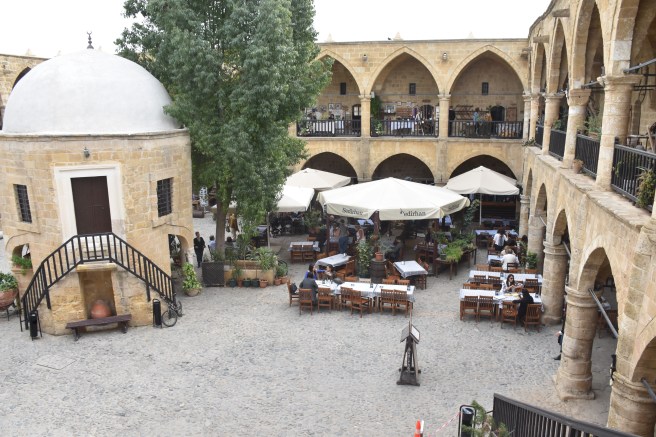
Our next trip was back to the coast to Girne, otherwise known as Kyrenia. Its here we found one of the few chandleries in the North, where we managed to get some of the boat stuff we were after. Girne also has a nice shopping district and some cool bars around the old harbour. But the highlight of Girne is undoubtedly Kyrenia Castle, right on the waterfront next to the old harbour.


We walked along very top of the castle and through its many nooks and crannies. Many of its rooms were taken over with museum exhibits including a shipwreck museum. The dungeons too got a good workout and this is where the exhibits got a little macabre. The shipwreck museum was also inside the castle and part of the admission fee.
The lowlight of Girne was the uneven footpath, where I tripped and bent my toe upwards in a reverse L shape. For all of you that kindly enquired, I was indeed completely sober at the time – on land and sober must be the most dangerous combination as far as my safety is concerned. The good news was that the said footpath was next street across from the Kyrenia Medical Centre.

Perfect place to take my north pointing toe. After seeing the GP and having some X-Rays taken, it was off to the orthopedic surgeon to have it straightened out and have a pin inserted. And all for 1500 turkish lira – less than $750 – bargain (for my travel insurance).
After spending a day with my foot up as per Doctor’s orders, it was time to resume exploring Northern Cyprus (not exactly Doctor’s orders). We took off along the Karpaz Peninsula, where La Mischief was parked. The peninsula is quite big, wild and exposed, with lovely beaches and an interesting monastery at the end, complete with some very friendly and somewhat bossy wild donkeys.
Then it was off to check out the castles, perched high in the mountain range.

We’d all ready done Kantara Castle, on the morning that I broke my toe, so that was a bit of good timing. They say that if you go to Kantara Castle on a clear day, you can see mountains of Syria. That’s a bit disconcerting, given whats going on in Syria, but it wasn’t the clearest day so no Syrian mountains were sighted.
My toe was well and truly broken by the time we go to Buffavento Castle. The 10 million steps up to this Castle were a bit tough on my new walking style, but I eventually got all the way up there. This was a great castle, with stunning 360 degree views once you reach the top.
Buffavento conquered, we continued onto St Hilarion. To get there, we drove through a military area including a firing range – fine as long as you just drive along the main road. It adds a little bit of spice to the visit. St Hilarion was where the King of Cyprus used to hang out and is therefore pretty upmarket as far as castles go. Great view overlooking Girne on the coast as well. Pretty extensive and pretty impressive.
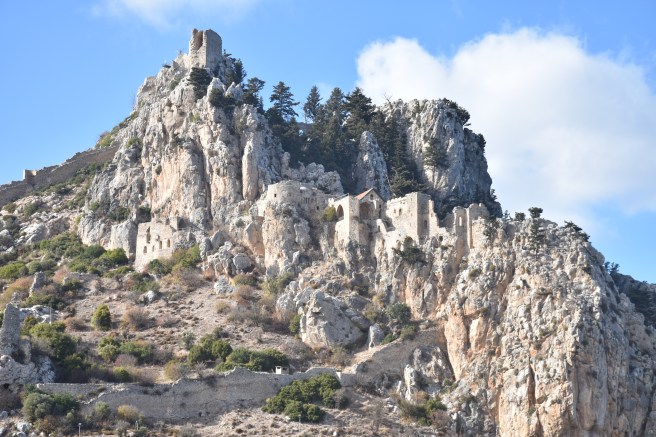 Moving right along, we continued on to Bellapais Abbey, just above Girne. It was a very picturesque mostastery, with an equally picturesque little village, with very narrow streets – a magnet for tourists.
The drive back from Girne to Karpaz takes about 90 minutes and is very spectacular – with coast on one side and mountains on the other.
Its good when you’re somewhere where you run out of time at about the same time as you run out of sights and thats what happened to us here. We spent the last couple of days packing up the boat before leaving for the airport to catch up with family and friends for Xmas.

So there – for the first time in a long time my blog is completely up to date!!!
See you in 2016 for more adventures 🙂

For photos of North Cyprus click here

Having given up on Famagusta, we decided to do an overnighter and end up in our final wintering spot being Karpaz Gate Marina. After a night of very little wind, we got there at about 8am in the morning and tied up waiting for the marina to open at 8.30am, which they duly did.
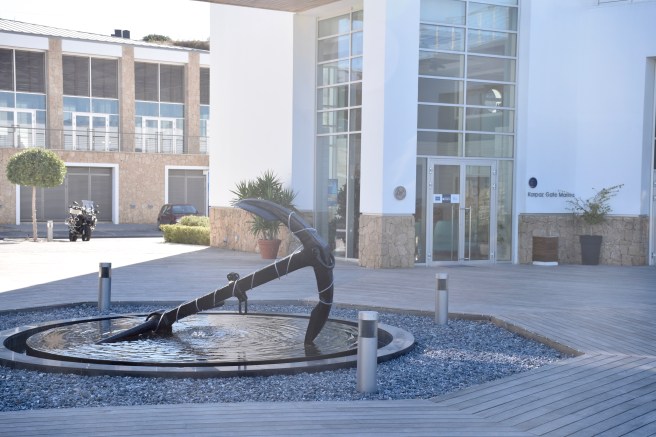
The Marina staff were excellent as they got us checked into the Turkish Republic of North Cyprus, a country only recognised by Turkey and nobody else. Hopefully the talks that are going on at the moment will see Cyprus reunited as one Country, with the Turks and Greeks who live there coexisting peacefully together like they did in the past. This will be a great and beautiful country when it finally happens.
We ended up on “E” jetty, tied up between two floating finger jetties – luxury! The Marina is probably about a quarter full, and is really cheap, especially considering the facilities and their quality. The downside is it is miles from nowhere. That’s okay for us as we used some money we saved in marina fees for a hire car; and at the end of the day we will not be spending a lot of time here, planning to do trips to Perth and California, then Jordan and Israel and then skiing in Europe before leaving and heading down to the Red Sea in late February.


The Red Sea idea came from a fellow marina resident, Walter, who has been down several times and was looking to go this year as well – until his daughter decided to make other plans. Hopefully, we will convince Walter to do the journey down with us (as well as some other sailors who have boats in Karpaz). Walter has kindly provided us with cruising and diving guides as well as lots of advice as we poured over his charts. Safety wise, I think we are fine as the Suez Canal is well protected and Hurghada, where we end up, is not on the Sinai. It looks too good an opportunity to pass up given we are so close to some of the best diving in the world.

Anyway, I digress.
Back to the Marina, which has got to be a well-kept secret. There’s only a few cruisers that are staying over in the marina for Winter and we are starting to get to know them with Happy Hour drinks on Saturday nights at the Hemingway Bar, and free Tuesday night movies (Mad Max and The Kingsmen so far – in English with Turkish subtitles).We are also starting to meet a few of the expat locals who have holiday homes here as well and we have settled into life at the marina quite well.

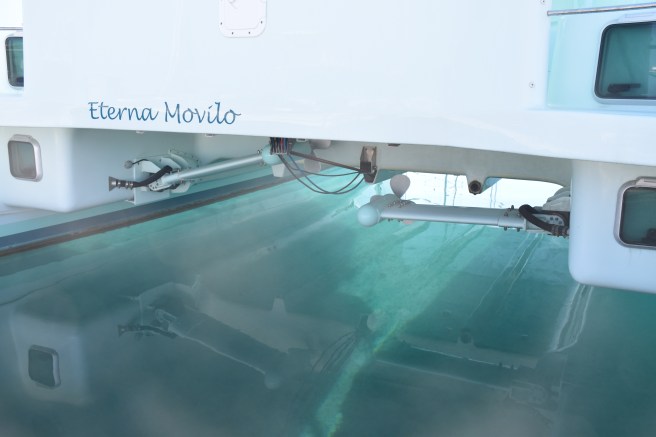
Our berth is right next door to an Electric Catamaran from African Cats, which belongs to Gideon (both the boat and the Company belongs to him). All carbon fibre, extremely light and fast with two retractable electric motors underneath, that can also generate electricity whilst sailing. Very interesting guy to talk to and it’s a pity that he and his wife flew off before we had much of a chance to pick their brains a bit more.
The marina itself has a bar, small minimarket, a gym, a chanderly, a great laundry and a dive shop and that’s about it. And a huge boat lift, which is evidently quite cheap also. In summer, it also has a pretty funky beach club with a beautiful pool, bar and Jacuzzi, but unfortunately it was closed when we got there.
What it doesn’t have is good Technical Services or the ability to source boat parts at a reasonable price, so forget about getting any work done here. However getting parts sent here was reasonably easy, got them VAT exempt out of Europe and we took delivery at the marina with no additional fees.
And finally, very importantly it has a marina dog!

Down the road, 4kms away is the nearest village. There is a free bus from the Marina every day at 9am. It gets a good workout on Monday when we all pile in and go to the Monday markets (great fruit and veggies), followed by tea and a chitchat at the village café afterwards. The village appeared pretty scant to start with, but after a while you discover all sorts of shops and bits and pieces. A Turkish haircut and shave was once again a highlight. This one came with a face pack and a massage.
As we got into December, the weather started to deteriorate and we got some great Mediterranean storms with sea spray hitting the high walls and covering the whole marina in salt. It was good to be tucked inside nice and safe (and warm). But now, that weather has passed and its tee-shirt and shorts weather during the day (but still cold at night).

No …Not our Ship…..
We’d tried a few times to organize a berth in Larnaca without luck. Once the word “Catamaran” is mentioned, the “Too Hard” sign goes up and the Answer “No” comes back. However, whilst in Limassol, we did a bit of a reconnoiter by car and saw there was a few potential spots in the oldish marina that we could fit into.
So we hatched up a cunning plan to just roll up and see what happened. We left Limassol earlyish and got to Larnaca about 2pm. After radioing in and getting no reply, we managed to get them on the phone. The marina was government owned and a bit run down, with no laid lines – just pylons that you back in between and tie off to. They directed us to one spot, which looked too tight and as much as we tried to fit, we just couldn’t. That was fun in 20-30kts of wind! We were then redirected to a much better spot amongst the tour boats, which was great, if a little noisy. The marina guy was really helpful (as are all Cypriots) and made sure we were tied up well on the pylons with water and electricity.
The other good news was it was incredibly cheap, being government owned and we found ourselves spending a few more nights than planned in Larnaca because of this.
The bikes quickly made another appearance and off we rode on the good bike paths to find a dive shop. We finally settled on Viking Divers, with Marco 1 and Marco 2 as our Italian dive masters.
Since we hadn’t dived for a while, we decided to do a couple of shore dives before doing the Zenobia Wreck, the day after. The shore dives did the job, the second dive was really cool with some cave swim throughs and an exit through a little blow hole, which you enter through a cave underneath a rock ledge.
The Zenobia capsized and sank in Larnaca Bay in 1980, sitting on the bottom at 42 meters. It sunk due to a software error – bloody computers!!! …, which caused her computerised pumping system to pump excess water into her side ballast tanks. Down went its cargo of 100 or so trucks worth $400 million, which makes for an interesting dive. The Zenobia regularly appears in various world’s top ten dive sites and world’s best wreck dives so we just had to don wetsuits and see what all the fuss was about.


We went out on Viking’s dive boat, only a 10 minute ride to the wreck which is only a mile or so off the town.
They take all certified divers on the wreck, which is a bit unusual given its depth but you can get a couple of good 25m dives on the wreck, including some swim throughs. Advanced certificates allow you to go down to 30m and see a bit more. It was my first nitrox dive, which allowed me to stay down longer without getting bent. Unfortunately it didn’t stop me being a air hog and I ended up having to buddy breath with Marco so I could stay down for the planned duration. Daughter Claire had a good laugh on this one. I also had some ear problems due to a head cold that was just starting up so I had to miss the second dive. But the first one was great and definitely worth doing when in Larnaca. It was pretty good but not sure its in my top 10 dive sites, given all the diving I’ve done elsewhere.
Zenobia Wreck Dive from Steve Tull on Vimeo.
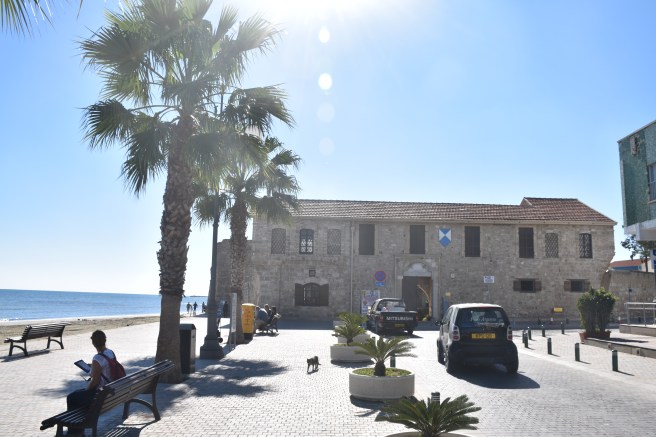
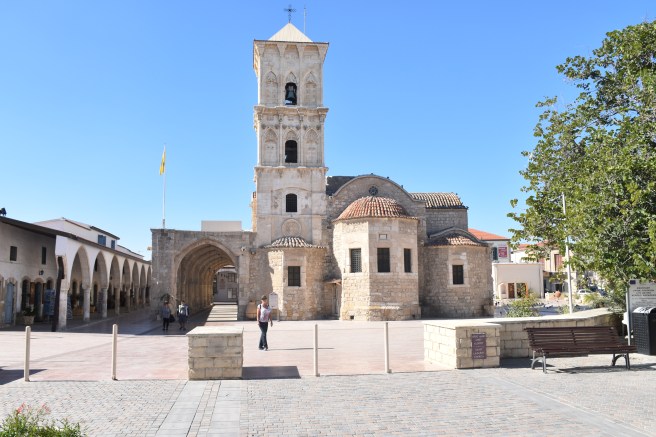
In between diving, we had a nice wander around the town. There’s the obligatory castle right on the waterfront and some nice sandy beaches out the front of the town. Behind the beachfront there is some walking streets with shops, bars and restaurants that come alive at night, which at this time of the year is 4.30pm in the afternoon.
With diving done, it was time to leave Larnaca. We wanted to head to Famagusta on the occupied side of the island. We’d heard you could go from south (unoccupied) to north (occupied) in a boat but not from north to south, as the Republic of Cyprus (the south) will claim you did not enter the country at a legal port of entry and then proceed to impound your boat and deport you (there is a boat on the hard in Larnaca that has been impounded).
So we went and saw the Marine Police and enquired about going to Famagusta. He was not very happy about it and pointed out the fact that we could never come back, which we could live with. However the Customs guy said he couldn’t give us a clearance out of Larnaca if we were going to Famagusta. He also said we could be picked up at sea with some nasty consequences.
A quick conference back at the boat determined that we would tell everyone we were now going to Turkey. Back at the Marine Police and Customs, they were most relieved with my change of plans and gave me the necessary clearances.

The sail up from Paphos was quite relaxing with a nice beam reach along the coast. We kept off the coast outside the yellow marker boys as we passed the British base.
In Limassol there are a couple of choices when it comes to Marinas. You have the convenient right next to the old town but very expensive (130 euros a night after a 50% discount) Limassol Marina or the way out of town but reasonably priced (56 euros a night) San Raphael Marina, which we opted for.
In Cyprus, you need to check in at every port with the Port Police. They give you a landing card and take your passports. When you leave they give you your passports back. Paros was the exception as they gave us our passports back there – which allowed us to cross the demilitarised zone into the occupied territories. No such opportunity at any of your other stops. Interestingly you don’t need a passport to hire a car here – just an Australian Drivers license.
When we were in Paphos, we drove through Limassol and checked out the old castle and the old town, both of which were pretty good and worth a look.


Dee got really excited when we spotted “A” off the beach. A huge funky looking $300M super yacht owned by, you guessed it, a Russian billionaire. We also saw it later in Paphos.


San Raphael was a good 8km ride from town along some great bike paths so it was out with the bikes to do some further exploring and lunching on the very nice beach front. We ended up riding all the way to the mall, which was right up the other end of town – a good 15km away.
The bikes were playing up so we decided they needed a good service. We found a good bike shop and dropped them off. They came back with a long list of salt-water induced problems. Time to stop storing the fenders in the same locker as the bikes! They needed a couple of days to service so we ended up hiring another car for a couple of days and driving to the East end of the island. There are some great beaches and resort towns up there but at this time of the year they were all winding down.
After 5 days in Limassol, we fuelled up at the very reasonable price of 1.08 euro a litre and headed off towards Larnaca.
For photos of Southern Cyprus click here.

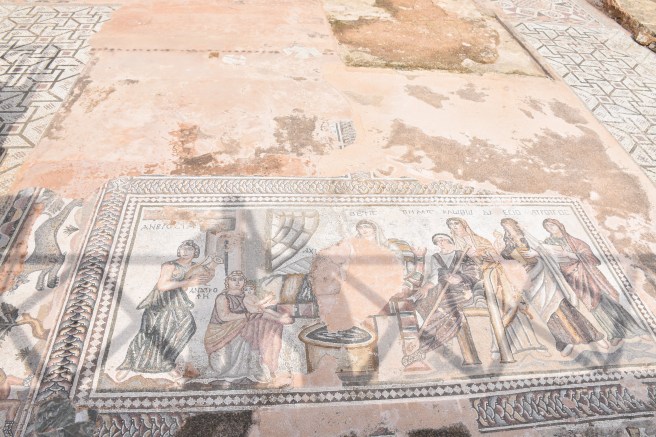
After successfully checking into Cyprus, it was off to explore. We started with checking out the Kato Paphos Archaeological Park, which is right next to the harbour. In particular, the House of Dionysus (the Greek God of Wine) is one of the largest and the most impressive ruins in the park, with some of the best mosaics that we have came across. Rightly so as it is said to have the most impressive mosaics in the Mediterranean.
After our quite extensive walk around the ruins, it was off to a great restaurant that Dimitri (from the Port Police) not only recommended to us but dropped us off at. We soon became impressed with both the Cyprus food, as well as with the local Cyprus wine, which turned out to be both very good and very cheap.
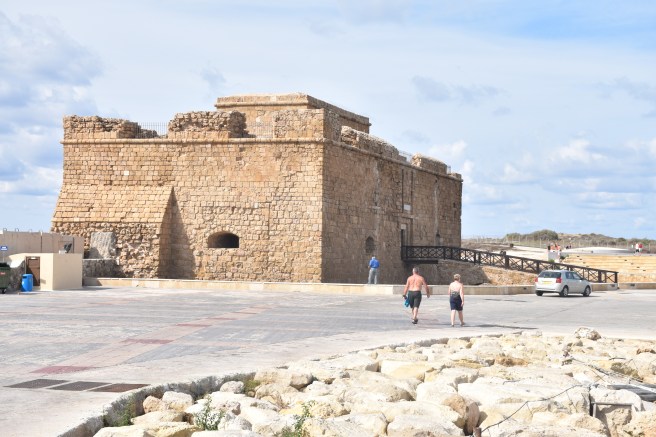
We then spent the rest of the afternoon checking out the cute seaside town with its nice beaches, great bars and restaurants and enough shopping to keep Dee interested.
Next morning we took a 40 minute walk along the coast on a great boardwalk up to the Tomb of Kings. Quite a bizarre place with all these tombs carved into the solid rock, most of which are underground. Many date back to the 4th century BC, and are thought to have been the burial sites of aristocrats and high officials (but interestingly – no Kings) up to the third century AD. Some of the tombs are quite elaborate, featuring Doric columns and frescoed walls.

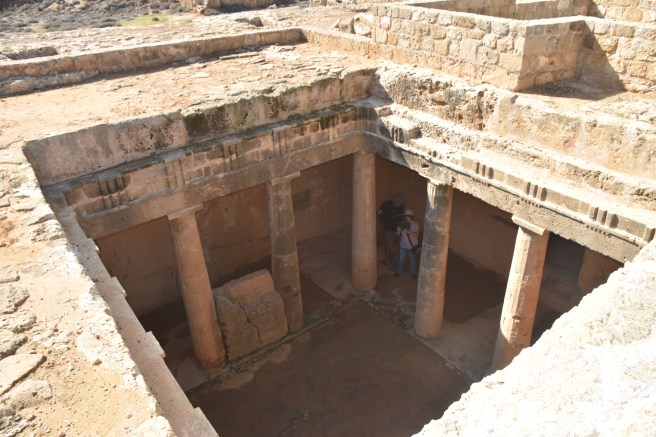
We walked back into town and found the Mall, supposedly the biggest in Cyprus. The fact that Cyprus was British up until the 1950’s, together with the large number of Poms living here, made us feel like we had suddenly been transported into Little Britain.
Our dose of modern “culture” over, it was time to head back again into ancient times. We headed off in search of St Paul’s Pillar where he was (allegedly) beaten when he first arrived in Paphos, the then Roman capital of Cyprus, before managing to convert the Roman head honcho of the Island. We found the pillar amongst a lovely ancient church grounds, along with interestingly enough the grave of Erik Evegod, the King of Denmark who was on his way to the Holy Lands when he suddenly dropped dead.


The weather in November was still holding up well so we got in a few ocean swims. We found a nice spot right in the town centre where all the locals conjugated for a swim and a chat, with nice showers and lockers. Beautiful clear water and interesting coastline to snorkel over.

We quickly fell in love with Pafos, with its lovely bars (one of which we visited to watch the All Blacks beat us in the final), restaurants, shops and friendly super people. Cyprus is actually one place in Europe where they give way to pedestrians. Everything is convenient, and with the large English population, you can get just about anything you want. We stocked up at Lidl’s as well as the local grog shop, as wine and spirits are dirt cheap here. We got out our bikes and found ourselves cycling around Pafos and its surrounds.

Since we had a cheap berth, we also took the opportunity to rent a car. We quickly found out that the shortest amount of time you can rent a car in Cyprus is 3 days – something to do with the insurance. So three days it was. At 240km long and 100km wide, Cypus is the 3rd largest island in the Med, there is plenty to see.
The first day we headed into the Troodos mountains, the largest mountain range in Cyprus. The highest peak is Mount Olympus at 1,952 meters, which hosts four ski slopes. There are lots of mountain resorts, Byzantine monasteries and churches on mountain peaks, with some pretty little villages clinging to terraced hill slopes.


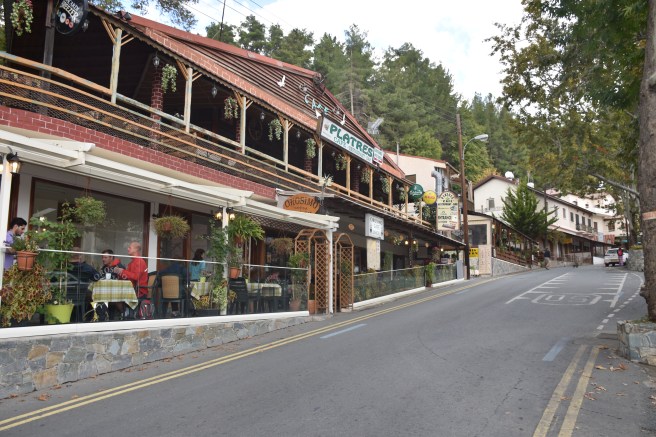
After checking out a few of these villages and very old churches, famous for their painted interiors (ten of these churches have been granted World Cultural Heritage status by UNESCO), we headed off to Nicosia, otherwise known as Lefkosa. A lot of the cities in Cyprus have two names – a Turkish name and a Greek name. Nicosia/Lefkosa is also a divided city with the southern half being the capital of the Republic of Cyprus and the northern sector being the capital of either the Occupied Territories, or the Turkish Republic of Cyprus, depending on your point of view. In between there is a UN Controlled de-militarized zone that runs across the whole island.
We had our passports so we did a short trip across the demilitarized zone to the Turkish sector to briefly check it out.

It was here that we dropped Hugh off so he could continue his adventures through Egypt, Jordan and Israel.
Next day, we continued our own exploration of Cyprus with a trip to Latchi, where we were planning to take La Mischief next, only to find out that there was no room at this publicly run marina. Good thing we checked. No big deal as we just extended our time at Paphos. The berth cost us 54 euros for the 7 or 8 days we were there.
Aphrodite is pretty big around these parts and we checked out a couple of her key sites. Outside Latchi is a spring that is attributed to her, and we also checked out the rock of Aphrodite, which emerges from the sea, and according to legend, its where Aphrodite was born in the sea foam and rose from the waves.


There are quite a few other great Roman, Greek and Medieval ruins dotted around the island. We bought a day ticket that covered entry to those we wanted to see on the road to Limmasol and we did a bit of ruin hopping. Top of the list was Kourion, which was full of beautiful mosaics, a very scenic Amphitheatre and palatial ruined villas all built on a cliff top overlooking Kourion beach. We also visited Kolossi Castle and the Sanctuary of Apollo and of course the Sanctuary of Aphrodite, where the cult of Aphrodite was officially established on Cyprus in 1500 BC.

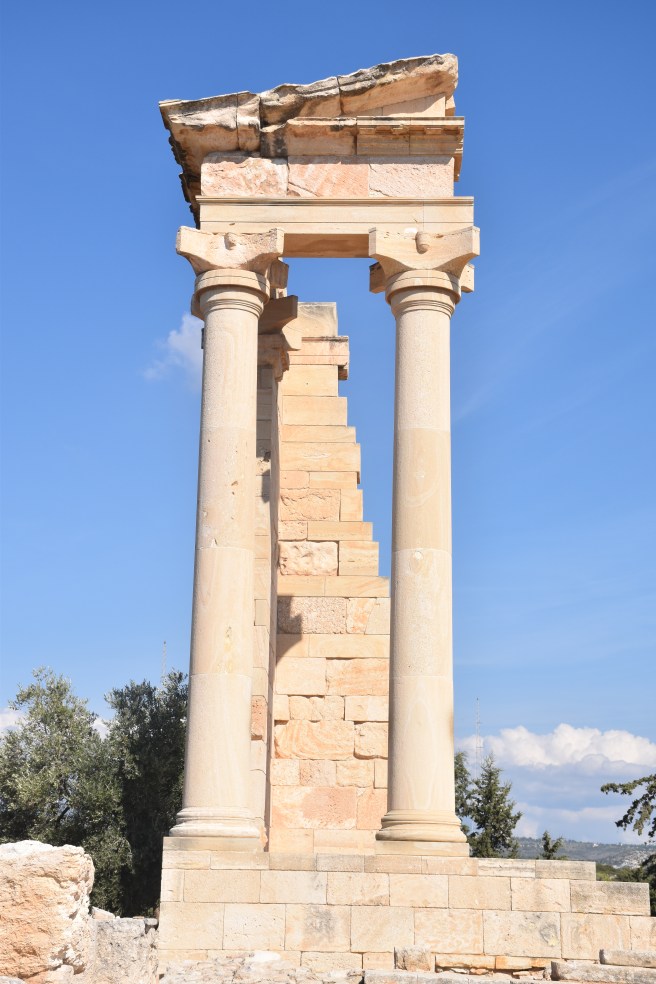
It was a very pleasant week and a bit when we pulled anchor and left for Limmasol, 50nm up the coast.
For photos of Pafos, click here.

The weather window looked great for the sail across to Cyprus – or should I say the motor sail as the winds were light and right behind us. You need to do an overnighter to Cyprus so that you arrive in daylight. Rod was hedging his bets about being able to check in at Paphos so we wanted to make sure we had enough daylight to push onto Limmersol as we needed to. As it turned out Paphos (Pafos) was fine as was Latsi further to the West as we later found out.
It was a very pleasant afternoon as we motored across at 6knots. We managed to get about an hours sail with our motors off before having to switch one back on as the wind died off.
As night fell, the lightening show started way off our port bow. Luckily it stayed off our port bow and didn’t get any closer. We were heading around the western side (the backside) of Cyprus on our way to Paphos. The three of us did 2 hour watches and that worked out really well as we each got two blocks of 4 hours sleep. It was great having Hugh on board helping out.

He was doing really well right up to the point where we decided to put our yellow immigration flag and the new Cyprus flag up just before we got there. He got the old Turkish flag off okay and then proceeded to hold only one end of the flag halyard. Looking up he saw the other end. Oops! So out with the bosun’s chair and up I went to recover the other end. There wasn’t much breeze but it was still reasonably rocky and rolly up there.
With flags in place we pulled into Paphos harbour at about 8.30am. The marine police told us to go stern to just next to their patrol boat, which was pretty much the only space available in this small harbour. We had one go at anchoring and the anchor just pulled through the sludge on the bottom without holding. The second attempt was much better, felt like we’d hooked something down there – who knows – but it held well.
Then it was off to see the marine police, customs, immigration, the health authorities(!) and the harbour master. Customs took about an hour to drive over from Limmersol and whilst I waited I was treated to two brilliant cups of tea and honey from Dimitri, the police captain. I went back to the boat to wait for Customs and Dimitri brought back the passports, unstamped but with a boarding pass. Bit strange but all good to go. We asked Dimitri where a good lunch spot was and he later drove us there. Really nice of him.
Then it was off to explore Paphos, where the whole town is ENESCO Word Heritage listed.

For photos of Paphos, click here.
The motor up to Alanya was pretty easy. Both the swell and wind had died down to nothing much at all. It was a good opportunity to get Hugh acquainted with La Mischief before our sea crossing to Cyprus. Hugh picked it up quite quickly, putting his past sailing experience to good use.
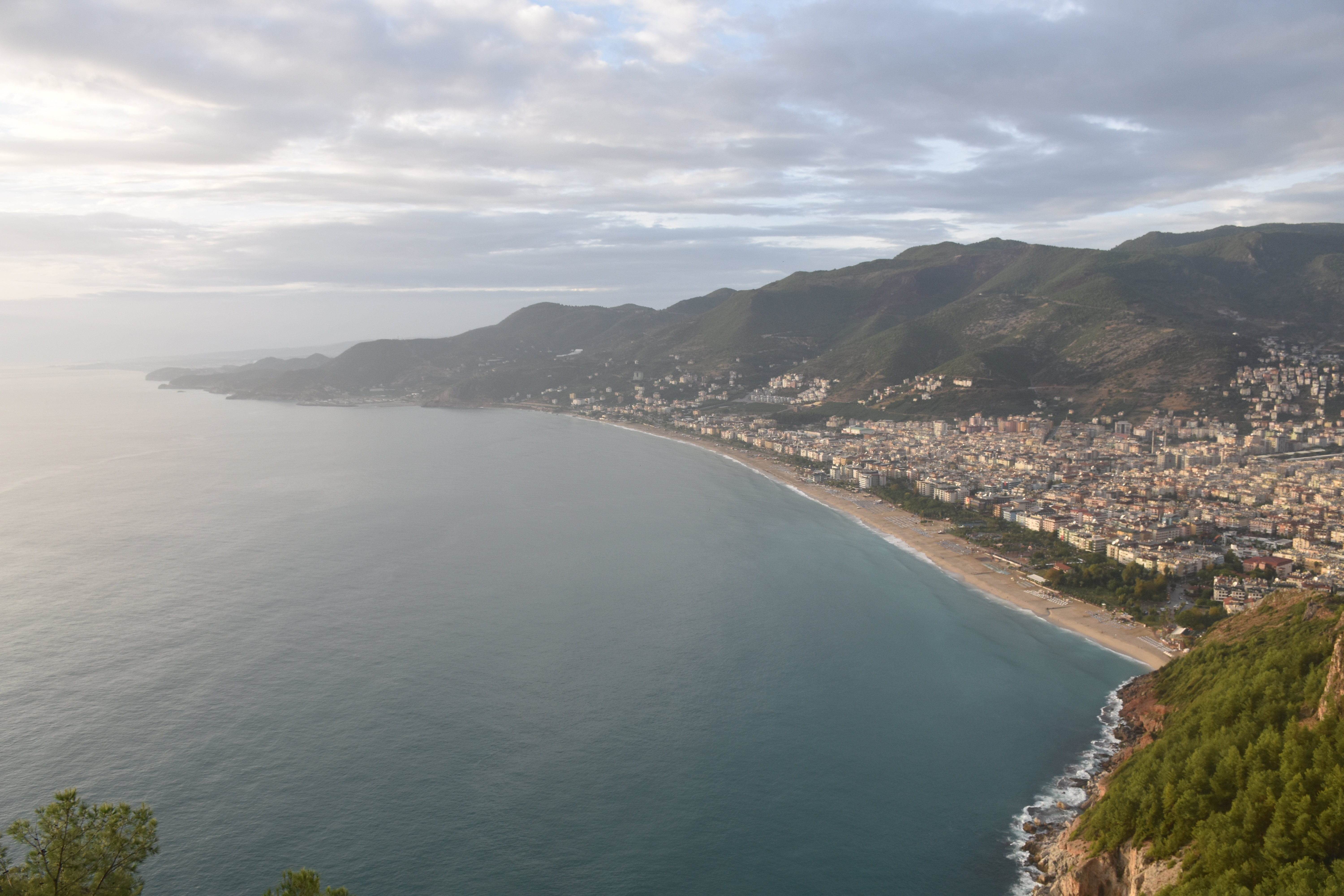
We hugged the coast and made it to Alanya about 2pm. We decided to bypass the Marina, which is 3km out of town and head for the town harbour as that seemed much more accessible.
The approach to Alanya was spectacular, with a couple of castles and some extensive walls perched high above on the cliff’s edge. Further around we passed the Ottoman Shipyards and the Red Tower as we motored into the old harbour.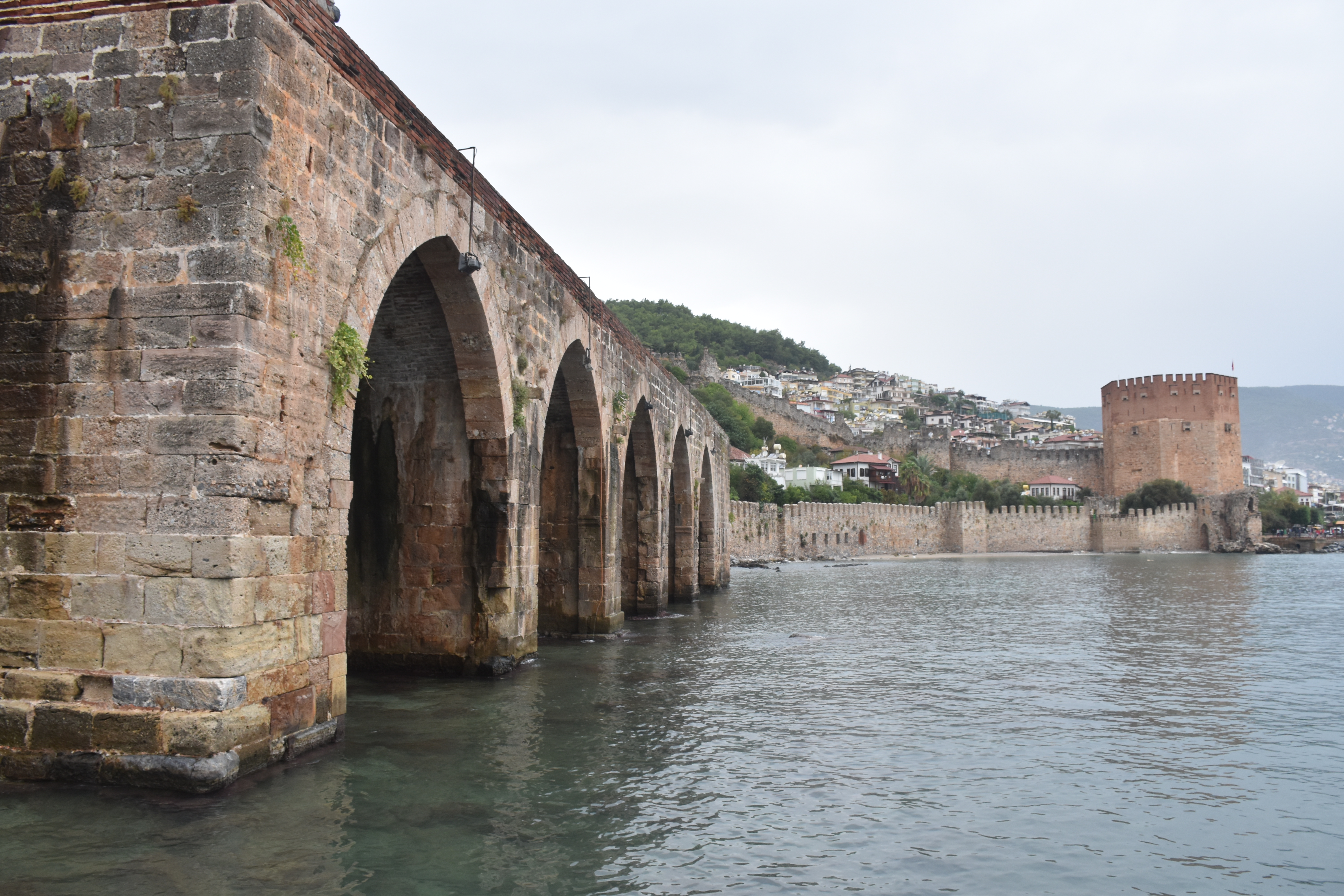
The harbour itself was quite big but quite full. We motored around looking for a spot and found a couple of harbour master staff who told us to go stern to near a work boat.
Safely berthed, we asked about getting an agent to help check us out of Turkey. A phonecall was made and all of a sudden it appeared we had a problem. It seemed his boss didn’t want us to stay in the old harbour and we should have gone to the marina as the harbour was only for commercial boats. Not to worry, if we paid him some cash, we could stay until 7am the next morning (ie. Before his boss got in!). The amount in cash started off at 50 euro and ended up at 30TL. I gave him 40TL so he saw it as a bit of a win – besides it was cheaper than the taxi ride from the marina to town, and off we went to explore Alanya.
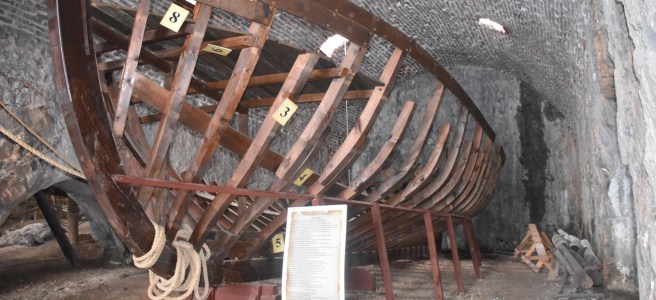
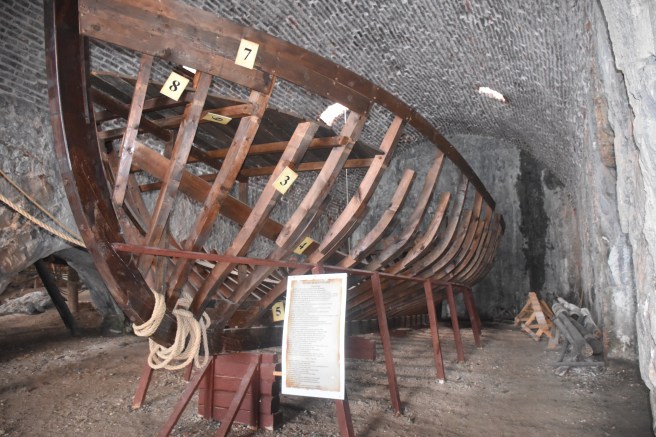
We started at the very impressive Ottoman boatyards, which were right around the corner from the harbour, and then climbed up the cliffs to see the two castles, and the magnificent views down to Cleopatra Beach to the marina in the distance. Unfortunately by the time we got back down to the Red Fort it was closed. We could have done with more than an afternoon to check out Alanya but we needed to get going to Cyprus.
 The good news was that the Rugby semi-final was about to start between Australia and Argentina. We wandered around the town and eventually found a bar where it was playing – in Dutch on some Euro sports channel. We’d watched the previous semi in Side with German commentary so we’d gotten used to it.
Next morning, fresh from Australia’s big win, we pulled anchor and headed off to the marina, where we needed to go to check out of Turkey. Bad news was that we needed to pay for a whole day even though we only stayed a couple of hours. And we had to drive back into town with the agent to the authorities who were – you guessed it – located at the old port. Oh well.
With our paperwork done and the necessary euros handed over; it was noon as we set off towards Paphos in Southern Cyprus, 110nm away.

Hindsight’s a wonderful thing. It would have been great if we had been able to make Alanya that day so we could bunker down in a nice marina, whilst the very bad storm that was forecast passed by.
However, we didn’t quite make it.
We left Kemer in overcast conditions and pointed our nose across the bay to where Alanya lay 60nm away. The first part of the day was okay as we had a 20kt wind coming in at a 30-40 degree angle off our nose. We were making good mileage at 7kts with one engine on, lamenting the fact that we had to bypass Antalya, where we would have been able to get into the old port (conditions willing), but agreeing that we needed to get to our final Turkish destination before the weather set in.
But what’s the saying about the best laid plans? About one-third away across the wind had picked up to 40kts and was straight on our nose. We were lucky to make 4kts as the swell began to rise.
We were suddenly looking at a 1am arrival in Alanya, which meant 12 more hours of bashing into a crap sea.
We veered 40 degrees off the wind and headed towards land thinking the fetch would be less, and we may be able to creep along the coast, which should keep the fetch and the swell down. Interestingly, our course took us straight towards Side, 30nm from Alanya.
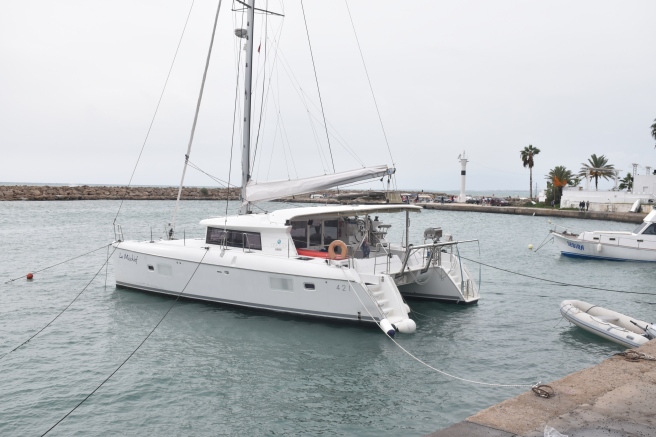
Now we’d been to Side on our road trip and spied the small harbour there. We’d read a blog of a yacht that had been caught there in bad weather and it was not that encouraging. However there appeared to be a good anchorage outside the harbour that had protection from the Easterlies that were building.
We got there about 3pm in the afternoon and poked our nose inside the small harbour to have a look. There was one other yacht in there, together with 5 or so gulets. We started to anchor next to the other yacht when Mustafa appeared and told us to both anchor and pick up a mooring in another spot, which we did. Mustafa turned out to be a fantastic guy and a godsend as he got us settled for the storm that was coming the next day.

It was about this time that the second yacht up’ed anchor and moved along the coast to the river at Manavgat, something we should have considered as well. Rod suggests that Side is not the greatest place in a southerly blow.
That night it rained cats and dogs and quite a few other animals. The wind got up a bit as the thunderstorm hit – it swung round to you guessed it – the south. Wasn’t very pleasant but the mooring and the anchor held. Next day Mustafa came and helped us attach a second mooring and we also attached long lines to the shore from our front and middle cleats to help take the strain off our back cleats. We also moved away from the quay and used the dingy to pull us between the boat and the wall. We were all set for another few days of bad weather, inside the harbor. Luckily for us the wind blew fairly consistently from the East for the rest of our stay in Side, getting up to 48kts at times as the swell bent round into the harbour and caused La Mischief to surge back and forwards on its port mooring lines. The narrow harbor entrance was unprotected by a breakwater and with the swell rolling in there was no way we were going anywhere else even if we wanted to.

Mustafa came round for drinks a couple of times and once brought fresh fish (besides being the harbor master, he also had a fishing boat and a tour boat). He came for lunch and cleaned, gutted and cooked his fish on the BBQ. Yum. He loved that his name was the same as Attaturk’s and had named his son Atta in his honor.
A few days into the storm, Hugh joined us. We’d met Hugh in Fethiye at the Rugby and he’d agreed to join us for the trip across to Cyprus. Hugh finished Uni a few years ago and is now a tour guide with Topdeck, having also spent time in South America. Not sure, what Hugh thought when he rolled up to find La Mischief riding out a pretty bad storm, but Hugh turned out to be calm and considered and took it all in his stride.

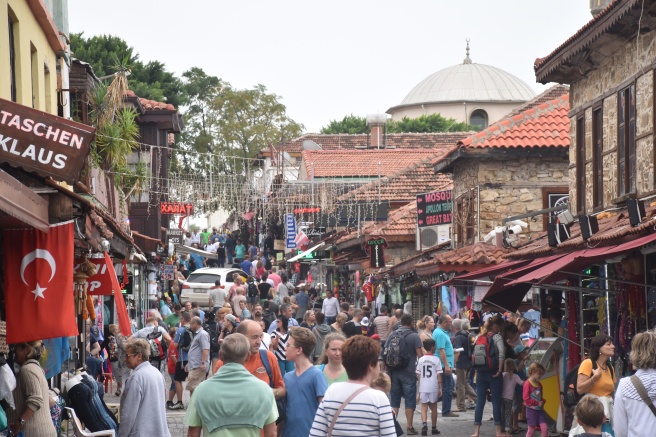
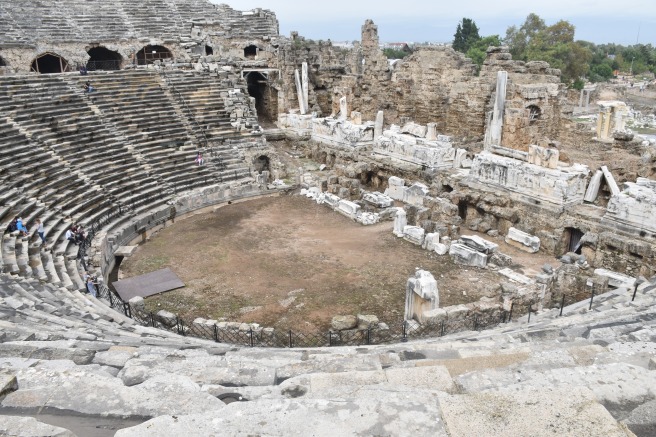
With some time to kill, the three of us went off exploring Side. It turned out to be a great place to be stranded for a few days as its great ruins are some of the most notable in Asia Minor. They cover a large promontory where a wall and a moat separate it from the mainland. There are colossal ruins of a theatre complex, the largest in this part of the woods, built much like a Roman amphitheatre that relies on arches to support the sheer verticals. The Roman style was adopted because Side lacked a convenient hillside that could be hollowed out in the usual Greek fashion. The theatre is big, seating 15,000 – 20,000 people. The temple of Apollo, right on the waterfront, with its wonderful Greek columns was being blasted by the sea spray. There’s also a good museum and some other Greek ruins that impressed us. The town too was good to wander through, with numerous walking streets on the small peninsula. There were some great beaches to the West with a nice promenade along them that we looked at but didn’t swim in. It was here that Hugh found his Putin on a Bear and Angela Merkel in a revealing top T-Shirts. Both absolute classics.
The second last morning we were there, a nasty thunderstorm came through and broke our port mooring. Luckily that was the last hoo-rar, and the wind quickly settled down after that. Not so for the swell as this took an extra day to abate.
Next day, we paid 200TL for a diver to repair the broken mooring, whilst Hugh took a dip to untangle the dingy painter from the prop, as it had somehow managed to get caught up in the last storm. The swell had settled enough for us to depart through the narrow entrance so then it was off to Alanya.
For photos of Side, click here.

